
This Facebook exchange from the Ancrum Village - Scottish Borders community page offers a fascinating micro-study in rural digital sociology. It captures how hyper-local social networks operate, the dynamics of informal surveillance, and the performance of rural community identity.

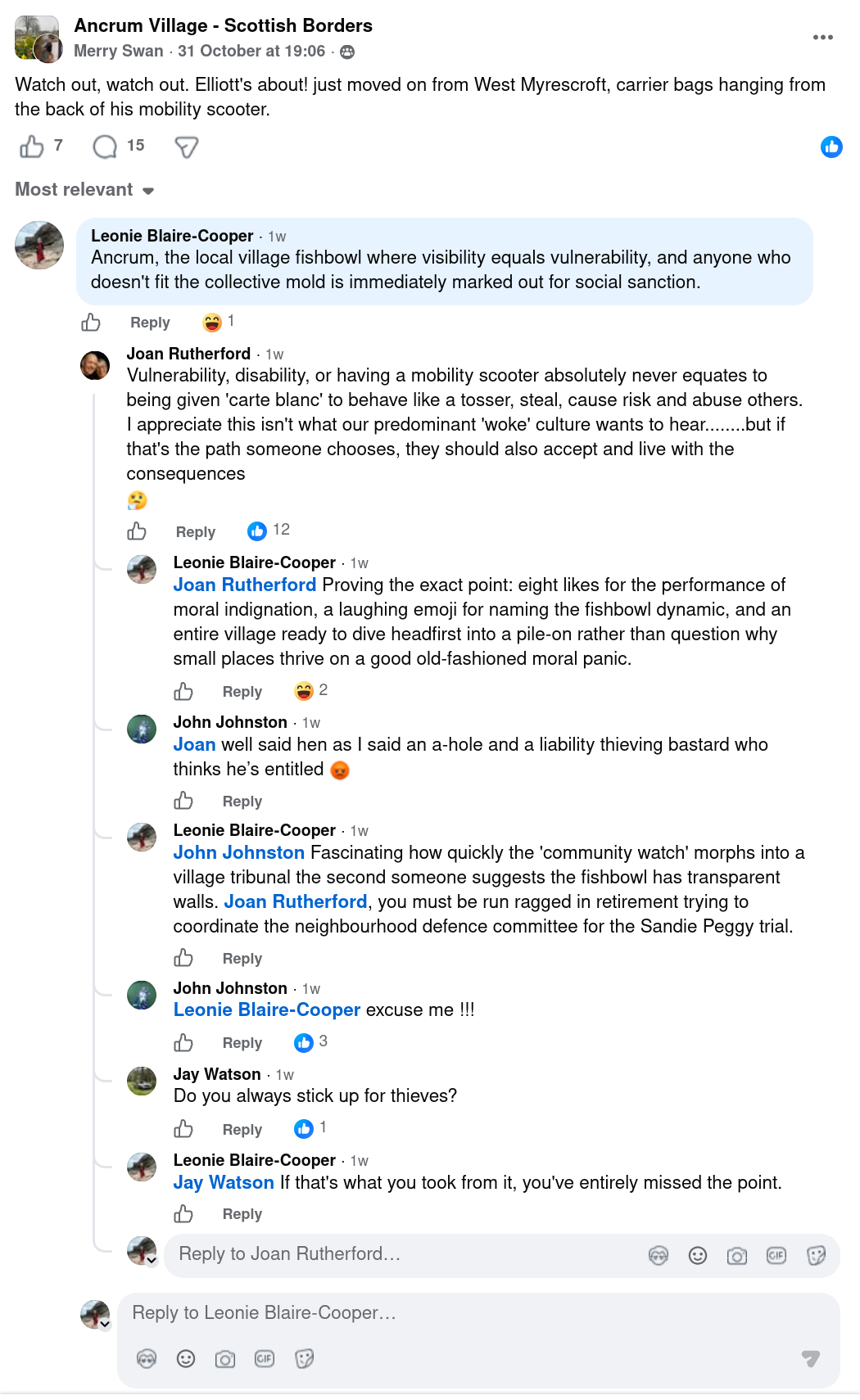
Screenshot date / time: Nov 13th 2026 at 7:42am, URL: https://www.facebook.com/groups/608356555996876/posts/3693954867437014
Here is a sociological breakdown of the post and its comments through several key lenses:
1. Informal Social Control and Panoptic Rural Surveillance
“Watch out, watch out. Elliott’s about! just moved on from West Myrescroft, carrier bags hanging from the back of his mobility scooter.”
In a small rural village like Ancrum, traditional institutional surveillance (like CCTV or heavy police presence) is replaced by informal social control.
- The "Panoptic" Village: Everyone is perpetually visible to everyone else. The phrase "Watch out, watch out" invokes a playful yet serious network of community alarm.
- Micromobility Tracking: The specific mention of “carrier bags hanging from the back of his mobility scooter” and tracking his movement from "West Myrescroft" highlights how granular local tracking becomes. An individual’s mundane transit is converted into public data, turning the community feed into an early-warning radar system for local gossip or nuisance behaviour.
2. Boundary Work and Deviance Labelling
The comments quickly move from tracking Elliott’s location to defining him as an outsider or a source of social friction:
- Joan Rutherford: "It's Halloween so he's probably out giusin' and by the sound of things, has succeeded in gliffing folk" (using Scots terms like giusin' for guising/trick-or-treating and gliffing for giving someone a fright).
- John Johnston: "A - hole"
- Susan Scott Scott: "He's a liability .... language like iv never heard before ..."
From a sociological perspective, this is classic deviance labelling (drawing on Howard Becker’s labelling theory). By publicly naming and categorising Elliott as "a liability" who uses shocking language, the community reinforces its collective moral boundaries. Deviance is managed not by the legal system, but through collective shaming and social exclusion on a public digital forum.
3. Vernacular Capital and Cultural Identity
The language used in the thread serves as a marker of regional identity and belonging:
- The rhythmic cadence of the opening post ("Watch out, watch out. Elliott’s about!") echoes traditional children’s rhymes, instantly signalling a shared folk culture.
- The deployment of Scots dialect ("giusin'", "gliffing") acts as linguistic boundary-keeping. It anchors the digital space firmly in the Scottish Borders, creating an in-group solidarity that separates locals from outsiders. To participate fluently in the digital village square, one must speak the cultural language.
4. Digital Folklore and the "Virtual Village Green"
Historically, rural gossip happened at the bus stop, the local shop, or the pub. Platforms like Facebook have transformed into the virtual village green.
- The Amplification of Minor Grievances: Low-stakes community annoyances (like someone driving a mobility scooter erratically with poor lighting, as noted by Linda Heard: "He came off the A68, one light on front working!!!!") are amplified into collective events.
- Therapeutic Venting: These threads act as an outlet for collective frustration. Because rural residents often have limited recourse for minor anti-social behaviour compared to urban dwellers, the community page provides a space to vent, validate each other's anxieties, and restore a sense of order through shared digital consensus.
5. The Metrics of Conformity: Likes, Laughter, and the Asymmetry of the Crowd
The underlying mechanics of the thread reveal an asymmetrical economy of digital metrics:
- The Overwhelmingly Liked Policing: The initial tracking, denunciation, and punitive commentary receive heavy endorsement via likes and upvotes from passive community members, creating an artificial consensus that validates the mob.
- Weaponised Laughter against Critique: When sociological critique is introduced to unmask the transparent walls of the fishbowl, it is met with laughing emojis. In the grammar of digital interaction, laughter functions as a mechanism of dismissal and dehumanisation—stripping intellectual critique of its weight by reducing it to a joke, thereby protecting the collective ego from self-awareness.
6. The Reflexive Defensive Rebound and the "Anti-Woke" Retort
When the digital fishbowl is intellectually unmasked, the collective exhibits textbook defensive rigidity:
- Displacement of Critique: Complex sociological observations regarding spatial policing are instantly flattened into culture-war tropes (e.g., Joan Rutherford framing critique as "what our predominant 'woke' culture wants to hear") to code dissent as an endorsement of bad behaviour or theft.
- The Binary Loyalty Test: Interlocutors demand absolute alignment with the pack (e.g., "Do you always stick up for thieves?"), revealing the reductionist logic underpinning reactionary spaces where any critique of the mob’s methodology is reframed as direct complicity with the deviant.
Conclusion
Ultimately, this brief Facebook thread is a microcosm of rural social cohesion: it demonstrates how a community uses digital tools to maintain safety, police social norms, and reinforce its distinct cultural identity through collective storytelling. When unmasked, the modern virtual village green sustains its internal cohesion through the targeted exclusion of non-conforming figures, turning local gossip into permanent, searchable public punishment backed by the silent applause and laughing reactions of the crowd
Footnotes & Academic References
- Becker, Howard S. (1963). Outsiders: Studies in the Sociology of Deviance. New York: The Free Press. (Applied via Section 2: Examining how public labelling and community categorisation construct deviance and enforce collective moral boundaries).
- Cohen, Stanley (2002). Folk Devils and Moral Panics: The Creation of the Mods and Rockers. London: Routledge. (Applied via Section 4 & 6: Analysing the amplification of minor grievances into collective moral panics and the subsequent defensive rebound).
- Douglas, Mary (1966). Purity and Danger: An Analysis of Concept of Pollution and Taboo. London: Routledge & Kegan Paul. (Applied via Section 2: Framing community responses to social friction as boundary maintenance against perceived social pollution).
- Foucault, Michel (1975). Discipline and Punish: The Birth of the Prison. New York: Random House. (Applied via Section 1: Interpreting the decentralised, peer-to-peer tracking of mobility scooters as a micro-panoptic grid replacing traditional institutional oversight).
 Léonie Blaire-Cooper