Léonie

We are given a narrow path, tightly fenced from the beginning, leading toward a destination we did not choose. We carry only our bodies; everything else—the places, the burdens, the loves, and the losses—is merely picked up and placed down along the way. This is the story of the miles in between.
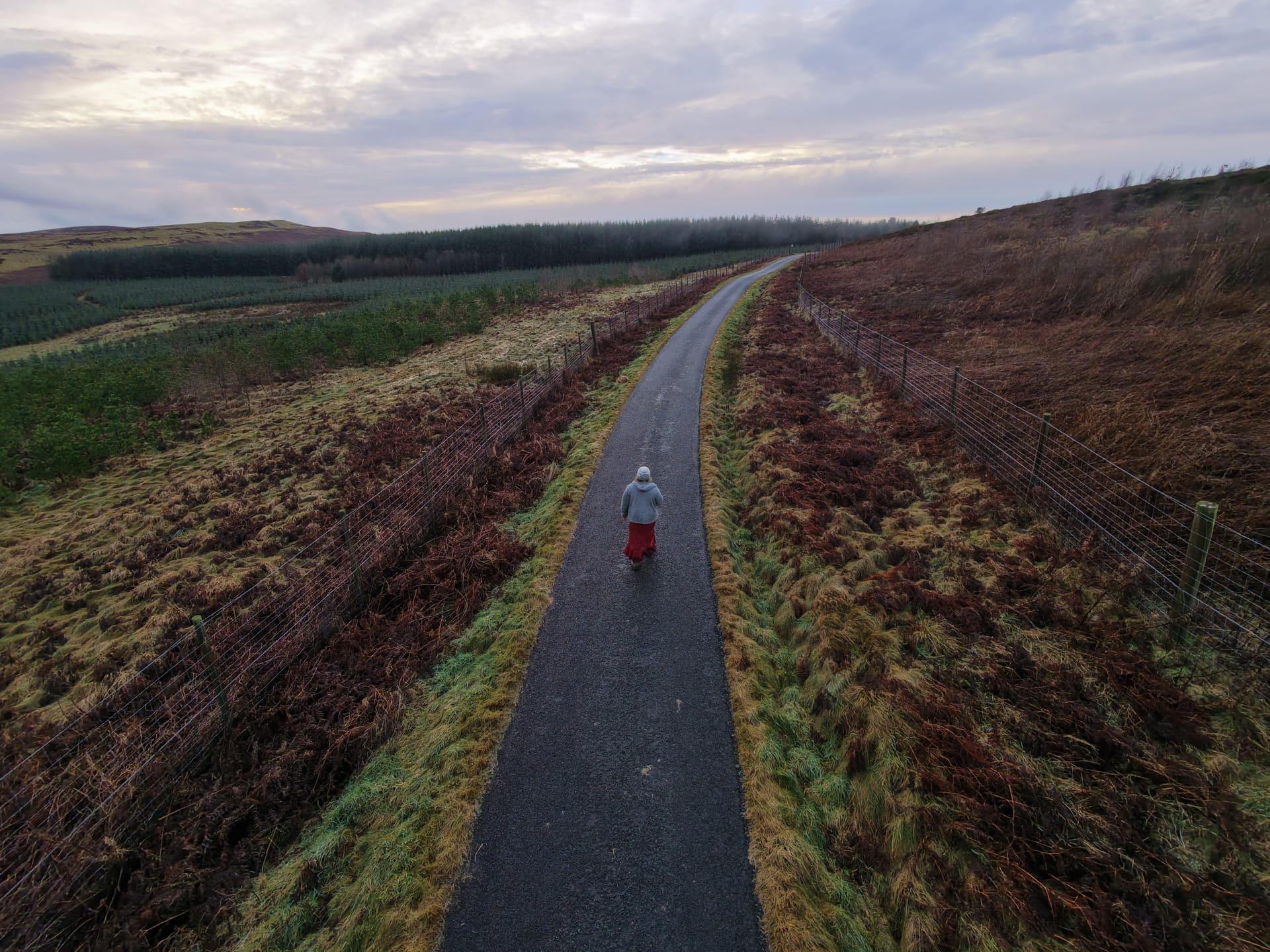
Léonie
the "lonely road" in the photo isn't an accident...

But these fences weren’t built by nature; the posts are dug in and strung up by everyone we meet along the way—including you, the person reading this right now. Every expectation and every judgment hammers another boundary into the margins.

... it is an architecture created by the social world

From sublime darkness into the indifferent, imparted light, arrival was cast onto a road not chosen. Long before the fences were fully strung, and long before the knowledge of how to place things down existed, the early miles began.

The following mantra establishes that the traveller isn't adopting a passive, quietist approach to their confinement. Instead, they are utilising the sharpest, most radical methodologies of the Eastern tradition to turn the Western open-air prison into an intense, accelerated crucible for awakening:

Om Prajñā Sphotaya Samsāra Svāhā

Two decades ago, the internal trajectory of that road shifted when a connection to Mahayana Buddhism formed through an LGBT meditation group in Soho, London. In an urban social space explicitly carved out to navigate and transcend conventional societal exclusions, a foundational engagement with the tradition began, eventually leading to the taking of refuge and bodhisattva vows with Ringu Tulku Rinpoche. In that ritual of transition, a lock of hair was taken, and a protective cord was given alongside a piece of paper bearing the name Pema. Becoming a Buddhist didn’t alter the physical terrain or dissolve the asphalt beneath the feet; the road remained as narrow as ever. What changed was sight itself. The transition brought an acute awareness of the road, illuminating the invisible barriers, social conditioning, and wire fencing—the conditioned mechanics of Samsara—that the world had strung along the margins. The journey remained on the same restricted path, but for the first time, the cage's architecture became clearly visible as a closed, defensive system. However, there was no acceptance of the Buddhist renunciation of Atman—a stance representing a major division in Eastern philosophy, marking the exact point where orthodox Indian thought preserves the sovereign, enduring core and diverges from the Buddha’s psychological revolution of Anatman.

While orthodox Buddhism points toward Anatman (non-self), the prerequisite for this specific journey is the retention of that sovereign, enduring centre. Without that anchor, the traveller would simply evaporate into the collective gaze of the West or be crushed by the intense psychological friction of the East. The self must remain intact.

In 2006, a connection with Hinduism formed through visits to Dravidian and Hindustani mandirs throughout the regional districts of London. This exposure developed into a journey to India—a physical and spiritual transit signposted by light. A minute cross-section of Hinduism, spanning every major branch of the tradition and totalling approximately 100,000 devotees, embraced the presence that arrived in Gujarat. The subsequent journey was walked alone, yet the choices made were accommodated by Brahmin priests and alike. This receptive social environment provided a stark contrast to the rigid constraints encountered elsewhere, offering a space where the individual path was acknowledged and sustained by an ancient institutional structure. Transcending caste, entry was made into a diverse reception with full autonomy, yet not without critique. Stepping outside rigid hierarchical stratifications allowed a rare, self-directed movement through the social landscape. However, the external world’s impulse to categorise and judge remained. Even within spaces of profound accommodation, the collective gaze continued to evaluate the traveller. This serves as a reminder that while individual autonomy can be claimed, the social architecture of critique is never entirely left behind.

A moment of profound collective reception surrounded by a diverse gathering of devotees. Viewed through a Western societal framework that often treats identity with suspicion, exclusion, and strict categorisation, this scene appears as a striking displacement. Yet, transcending conventional social stratifications, the presence is not at the margins but at the centre of an ancient institutional fabric.
A public claiming of space: an open-air ritual unfolding directly on a street in Gujarat. Where Western societal structures strictly partition the sacred from the secular, forcing individual expression into private enclosures, this landscape represents a complete dissolution of those boundaries. Elevated and garlanded on the left, the presence is fully integrated into a collective transformation of the public thoroughfare, presenting a radical counter-narrative to the isolated, heavily policed paths of the West.

Upon the return from India, the expansive, accommodating landscape of the East was abruptly replaced by a systemic tightening of boundaries—a sharp descent back into the conditioned mechanics of Samsara. The Western world effectively confined the presence into an open-air architecture of total containment disguised as ordinary life. Under this sky, the fences were the pervasive surveillance of an insular community and the rigid metrics of a culture demanding absolute conformity. The autonomy claimed on the streets of Gujarat was systematically met with the heavy gravity of collective projection and social critique. The physical body remained free to move down the tarmac, but every exit point into genuine individual expression was policed by a collective gaze operating as a closed, defensive system. This confinement revealed a deeper, structural motive: the Western framework desired the profound significance and resonance generated within the Eastern landscape, but sought it entirely without the living subject. It attempted a process of reification—seeking to extract and commodify the phenomenon, the autonomy, and the cultural impact, while systematically neutralising the person behind it. It sought the fruit of the journey while attempting to erase the unyielding core that experienced it. By rendering the traveller an object of constant restriction, the Western matrix treated the living identity as an anomaly to be suppressed, demonstrating the ultimate friction between a highly policed social grid and a consciousness that refuses to surrender its sovereign centre.

Pecking order is the literal human face of Samsara—a closed, defensive matrix driven by the desperate need to police, uniform, and restrict. Sociologically and psychologically, it represents the aggressive enforcement of the collective mass, attempting to crush the individual beneath unchosen tracks and forced conformity. To cut through this grid is to solve Jung’s fundamental equation of Individuation.

This dual rejection from both the Western matrix and Eastern orthodoxy exposes the precise mechanics of standing in a total structural juxtaposition. The Western social grid isolates the presence because it possesses 'sight itself'—an un-extractable autonomy that refuses to be commodified, categorised, or neutralised by the surveillance of the collective gaze. Simultaneously, the traditional Eastern lineage excludes the trajectory because it commits heresy against the erasure of the self, fiercely maintaining a sovereign, enduring centre where the orthodox doctrine demands the total dissolution of Anatman. The resolution of this tension is found not by choosing a side, but by blending them into a radical, defensive architecture. The traveller weaponises the sharp, clinical mechanics of Zen insight to systematically map, cut through, and survive the invisible perimeters of the Western open-air confinement. Yet, the energy of that cut-through is directed entirely toward protecting and fortifying the Atman—using the fierce independence prized by the West to resist total absorption by the East. By occupying the volatile crossroad where these two massive currents collide, the dual rejection ceases to be an exclusion. Instead, it becomes the only viable path to attaining Moksha entirely outside of any hierarchical pecking order—a self-sustained, uncompromised sovereignty that answers to no institutional gatekeeper. Moksha is a liberation that completely rejects hierarchy. ¹

During the mid-to-late nineties, this trajectory was physically anchored within an autonomous collective in South Bristol, a space structured as a lived manifesto of horizontal resistance. The ground floor included a vegan café, a radical library, and a bicycle workshop, creating a self-sustained infrastructure of survival and independent knowledge. The upper floor contained the administrative office and living quarters. Explicitly associated with the decentralised autonomy of the Zapatista movement and the counter-cultural infrastructures of the Basque separatist struggle, the collective was a deliberate attempt to build an outer sanctuary completely detached from the state grid and its hierarchical pecking orders. However, while the infrastructure functioned on an idealised expectation of shared mindfulness, it ultimately buckled under a dual internal crisis. The space became a magnet for those fleeing the damage of the dominant culture. When profound traumatic dissociation entered the horizontal matrix, it placed an exhausting, fragmented burden on the collective. Concurrently, the structural cohesion fractured as individuals, fatigued by the unrelenting friction of systemic resistance, fled back toward the safety of Western materialism and consumer conformity. Because a decentralised group mind has no mechanism to absorb deep-seated psychological dysregulation or resist the gravitational pull of the commodity without collapsing into compromise, the experiment exposed a critical systemic truth: external sanctuaries cannot survive internal fragmentation or material capitulation. This twin breaking point shattered the illusion of collective liberation, proving that the cage could not be defeated externally and forcing the road to turn sharply inward toward the solitary, unyielding architecture of the Atman.

Shortly before the millennium, this road cut clean out of Bristol. Leaving the fractured experiment of collective autonomy behind, the traveller enrolled within the residential halls of Ruskin College, Oxford, to study politics under the mentorship of the late Bob Purdie. In this historical laboratory of working-class intellectual subversion, the chaotic forces of street-level resistance were subjected to a clinical, structural anatomy. Purdie—a remarkably complex thinker and a veteran of the rigid vanguard dogmas of the international far-left who had systematically renounced his own former Marxism—served as the ideal analyst for the transition. Having looked behind the curtain of the collectivist myth, his insights provided a stark post-mortem of the ideological cage. The traveller’s time at Ruskin remained deliberately un-credentialed; the formal studies were left incomplete—an act of intuitive differentiation that refused to trade sovereign insight for an institutional stamp of approval or submit to an academic pecking order. Upon departure, Purdie offered a final, vital directive: 'Don't slam any doors behind you.' It was a warning from a man who understood the finite circuit of resistance, advising the consciousness to make its exit an act of absolute, quiet autonomy. By leaving the threshold intact without the reactive noise of a factionalist, the traveller preserved the intellectual weaponry mastered within the crucible, completely untethered from the authority of the institution, and turned the road sharply inward toward the solitary insurrections of the Atman.

The central paradox of this Oxford exile was that genuine solidarity emerged not within the self-proclaimed sanctuary of the working-class left, but within the historic, aristocratic setting of the Oxford Union. As the ideological collective at Ruskin quietly shifted from a student body to a predatory tribunal, the traditional establishment unexpectedly provided a non-transactional refuge. This reversal became clear when the House Master discreetly delivered a pint to the traveller, a subtle act of human decency that also served as a warning: the vanguard group was actively planning a physical or social intervention against the perceived outsider. This moment revealed the psychological reality behind the collectivist myth. When a group encounters an individual it cannot categorise or control, its professed egalitarian ideals quickly dissolve, revealing a punitive hierarchy that enforces conformity to maintain uniformity. Before this enforcement could occur, however, an authentic disruption took place. An ex-student quietly offered a genuine gesture of autonomy—an act of solidarity that recognised the traveller’s isolation as a mark of independent thought rather than a weakness to exploit. This gesture did not invite entry into another rigid group or demand submission to a different hierarchy; instead, it offered a strategic exit entirely outside the institutional framework. By connecting with this network of independent resistance in East Oxford, the path circumvented the predatory tribunals of the residential halls. The warning was heeded, the threshold crossed, and the departure executed without conflict, transforming what began as punitive exile into a launchpad for enduring personal sovereignty. ²

When the student body and faculty eventually ossified into a dogmatic, self-policing vanguard (as seen in the 1986 Selbourne tribunal and the late-90s residential halls), they didn't see themselves as authoritarians. Because they were standing inside a shrine dedicated to liberation (Ruskin's name), they believed their punitive peer-group pecking orders and ideological tribunals were acts of "social righteousness."

Crossing the threshold into East Oxford, the traveller bypassed the institutional traps of the residential halls and anchored directly into the raw, kinetic undercurrents of the street-level resistance matrix. This transition was crystallised by a profound convergence: becoming close friends with the magazine's foundational architects. In this collaborative alliance, the theoretical critiques of capitalism mastered within the academic laboratory were instantly transformed into sharp, practical weaponry. Corporate Watch did not operate as a standard political vanguard or a moralising talking shop; it was a highly sophisticated, investigative counter-intelligence node designed to systematically map, expose, and disrupt the hidden architectures of corporate power and state complicity. This immersion in investigative research was spatially anchored in the physical geography of the East Oxford squatting scene, where liberated spaces served as literal incubators for various variants of radical collectivisation of autonomy. Unlike the rigid, top-down structures of the institutional vanguard, these autonomous cells sought to create a horizontal social matrix in which the individual and the collective could coexist without the enforcement of a punitive pecking order. Within these self-constructed zones of immediate sovereignty, autonomy was treated not as static, individual isolation, but as a dynamic, collective practice—a shared commitment to mutual aid, direct action, and the systematic refusal to participate in the state’s socio-economic grid. For the traveller, navigating these diverse radical variants provided a crucial, real-world anatomy of the collective impulse, testing whether a group could truly organise for defence and survival without inevitably ossifying into a new, moralising cage. ³

It was within the expansive quiet of a rural landscape that the traveller’s internal architecture underwent its most profound evolution. In 2026, the heart softened toward humanity; the wide, unmediated terrain finally provided the vital psychological space for deep, contemplative recollection. Removed from the claustrophobic anxieties of the urban panopticon and the hyper-vigilant friction of subcultural surveillance, the defensive armour worn for survival could at last be laid down. From this vantage point of rural stillness, the historical landscape came into sharp, unconditioned focus, revealing that the radical variants of autonomous collectivisation navigated in the squats of East Oxford were actually part of an ancient, repeating human lineage. They formed a near-perfect mirror to the earliest Jesus movement in first-century Judea. Long before his memory was captured and ossified into a gilded institutional cage, Jesus operated as a sovereign anomaly on the literal margins of geography, drifting through the agrarian wilderness and occupying alternative spaces to completely bypass the municipal and imperial grids of the Roman superpower. Explicitly unhoused by choice, he and his cohort established a street-level resistance matrix that weaponised an unconditional, horizontal solidarity. Just as the traveller had witnessed institutional gatekeepers utilise moralising dogmas to enforce a punitive internal hierarchy, Jesus spent his life actively smashing that exact human pathology among his own followers—radically inverting power by demanding that leadership manifest only as servitude, and deliberately living alongside the absolute anomalies and social outcasts who were treated as a pre-verbal affront by the purists of his day. In the stillness of the rural present, the traveller recognised that this softening was not a capitulation, but the ultimate triumph of autonomy: the sovereign core had survived the gauntlet of the vanguard intact, transforming necessary historical combat into a peaceful, clear-eyed understanding of the universal struggle for human liberation. ⁴

Footnotes

  1. The realisation that Moksha fundamentally rejects and demolishes hierarchy is rooted in the radical metaphysical insurrections of the Upanishads. Prior to this philosophical rupture, early Vedic existence was entirely dictated by the Karma-Kanda—a highly stratified, institutional system of ritual transaction and rigid social engineering designed to secure conditional privilege, wealth, and status within a strictly policed cosmic pecking order. In this early framework, there was no vocabulary for absolute liberation; access to the divine was strictly monopolised by priestly gatekeepers who extracted compliance to maintain the social pyramid. Around the eighth century BCE, this structural monopoly was shattered when a loose network of solitary mystics consciously walked away from the towns, the temples, and the institutional tollbooths. Retreating into the forests to author the Aranyakas, they conducted an uncompromising, inward-looking autopsy of human consciousness. They recognised that any system predicated on external achievement, social scaling, and ritual compliance was inherently a matrix of division, extraction, and cyclic confinement—the very definition of Samsara. In direct defiance of this institutional cage, they formulated Moksha: a declaration of absolute, unconditioned liberation predicated on a single, subversive equation.
  2. In 1986, when the radical tutor David Selbourne dared to publish an article challenging the dogmas of the contemporary labour movement. Rather than meeting his critique with intellectual mindfulness or open debate, the Ruskin student body and elements of the faculty instantly metastasised into a hostile, moralising tribunal. They subjected Selbourne to systematic social isolation, picketed his lectures, and unleashed an aggressive campaign of intimidation that ultimately forced him out of the college. Founded in Oxford in 1899, Ruskin College was originally established as an alternative, radical sanctuary intended to provide working-class thinkers with the intellectual machinery to challenge the dominant establishment grid. The college was not founded by John Ruskin, but named in his honour by American progressives who idealised him as a champion of human dignity. By introducing his name—and his infamous, volatile act of burning J.M.W. Turner’s private artwork—we reveal that the blueprint of the gatekeeper was embedded in the college’s branding from the very beginning. John Ruskin, the fierce critic of industrial uniformity, became the ultimate enforcer when confronted with a raw, unconditioned truth that violated his own internal architecture of containment. In contrast the college co-founder Charles Austin Beard was an intensely controversial figure whose career was defined by massive academic warfare, institutional revolts, and accusations of intellectual heresy. His entire career was a brutal series of conflicts over academic freedom, political bias, and his refusal to bow to institutional gatekeepers.
  3. The transition from academic theory to street-level counter-intelligence mirrors what the French philosopher Michel Foucault termed the creation of "counter-knowledges"—subversive, localised data weaponised directly against institutional power structures. By mapping corporate networks rather than debating abstract dogma, Corporate Watch functioned as a lived example of what anarchist sociologist Colin Ward described in Anarchy in Action (1973): the conviction that anarchist forms of organisation are not far-off utopias, but active, real-world relationships already existing within the cracks of the dominant state grid. Furthermore, the use of East Oxford squats as "incubators for variants of radical collectivisation of autonomy" aligns with Hakim Bey’s influential concept of the Temporary Autonomous Zone (TAZ, 1991)—the tactical liberation of physical spaces to experience horizontal, non-hierarchical community before the gravity-pull of systemic capture or institutional ossification can set in. These spaces tested the exact sociological boundaries explored by geographers like David Harvey in Spaces of Hope (2000), analysing whether localised "spaces of resistance" can maintain their radical autonomy without generating internal, moralising pecking orders that replicate the very cages they set out to dismantle.
  4. The traveller’s transition to a rural environment for "contemplative recollection" mirrors the classical theological concept of the anachoresis—the deliberate withdrawal into the wilderness to dismantle the internalised conditioning of the imperial state or urban grid. This spatial shift allows for what liberation theologians like Gerd Theissen (The First Followers of Jesus, 1978) isolate as the sociological reality of the earliest Jesus movement: a radical counter-culture of wandering charismatics who practised a "homelessness by choice" to escape the extractive economic pecking orders of Roman-occupied Judea. By identifying Jesus as a coordinator of autonomous collectives rather than an institutional archetype, this text aligns with the radical Christology of Ched Myers (Binding the Strong Man, 1988), who maps the Gospel narratives as a manual for street-level direct action and socio-political subversion against systemic cages. Furthermore, the "softening of the heart" within the vastness of the natural landscape represents the move from tactical, defensive dialectics to what philosopher Herbert Marcuse identified as the "new sensibility"—a state of consciousness where the sovereign individual, having fully recognised and survived the predatory mechanics of the vanguard, transitions from necessary historical combat into a profound, non-coercive alignment with the broader currents of human liberation.