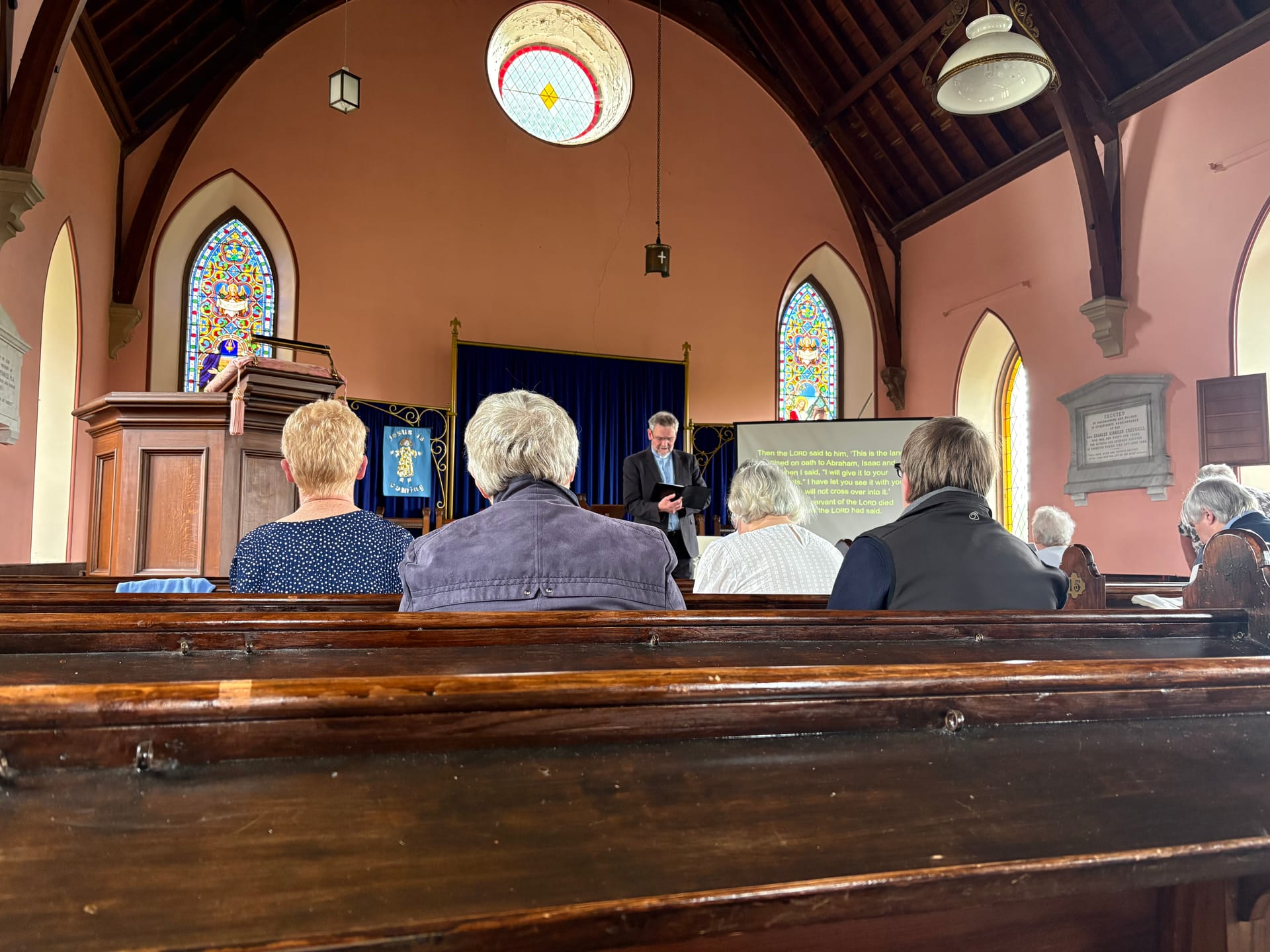
To look around the pews of Roberton Kirk today was to look at a community facing an absolute demographic and institutional horizon. The scale of what is hanging in the balance along the Borthwick Water is best measured not in sweeping presbytery decrees, but in empty spaces. Sitting with Charlie in the vacant expanse of aisle thirty-three, the sheer size of the kirk—built to echo with the collective voice of an entire bustling valley—felt heavy. Aisle thirty-three should have been filled with the rustle of hymn books, the whispered greetings of neighbours, and the generational continuity of families who have worked this land since this parish was formally constituted in 1659. Instead, it was an island of empty, polished timber.
From this vantage point, watching the congregation face the pulpit, a stark realisation set in: at fifty-two, I was the youngest person in the room. The observation didn't just highlight a generational gap; it felt like a sociological line in the sand. Here were the final, silver-haired guardians of a local tradition, clad in heavy winter layers against the quiet chill of the building, acutely aware that there is no younger generation standing behind them to inherit the keys.
If you wanted a visual metaphor for the day, it was projected in stark digital type against the pink-hued walls of the chancel. Beside a brilliant, timeless stained-glass window throwing ancient light into the room, a temporary digital projector screen displayed the final words of Moses looking out over a future he could see but might not inhabit: “This is the land... I have let you see it with your eyes, but you will not cross over into it.”
As the sermon progressed, the words from the pulpit occasionally betrayed the modern church’s tendency to look outward for its anchors rather than downward into its own soil. Reverend Cooke made mention of Martin Luther King Jr.—a reference that caused a momentary pause of reflection in the quiet room. In a remote Border kirk with a fierce, indigenous history of ecclesiastical rebellion, the invocation of a sanitised global icon felt oddly displaced. One couldn't help but feel that a Scottish reformer, or a nod to the radical Covenanters who once held illegal field preachings in these very hills, would have carried a far more potent resonance. The Borders have never needed to look across the Atlantic to understand the cost of standing up to institutional overreach; the lineage of local defiance was already baked into the landscape, making the generic reference feel like a missed opportunity to ground the day’s heavy crossroads in the historic grit of the Scottish soul.
As the minister read on, the reality of the immediate crossroads remained front and centre. Reverend Alistair Cooke did not announce the definitive closure of the church; instead, he laid out a fragile, heavy path forward. The building is due to be sold, yet he spoke openly of the possibility of keeping it—of the community rallying to save their kirk. But looking around the room, optimism is hard to find. The math of the pews is unforgiving, and the market logic outside them is equally sharp. Unlike many historic rural parishes, Roberton Kirk does not possess a surrounding graveyard. In the cold calculus of property disposal, this absence of a cemetery dramatically inflates its market value. Unencumbered by the immense legal liabilities, burial rights, and strict planning protections that come with human remains, the building stands as a highly viable, attractive asset for private development. The very physical layout of the land puts a target on its back that an encumbered church would escape.
Should the sale go through, the congregation faces a daunting geographic dislocation: the parish is due to be absorbed by Hawick South Church, six miles away. In the rural Borders, six miles is not a minor detour; it is an entire social and physical chasm. It marks the systemic pulling of rural life into the larger urban centres, stripping the glens of their self-reliance. For an ageing congregation, that journey to Hawick South represents a logistical barrier that threatens to scatter the remaining flock entirely, turning a localised community anchor into a distant, detached destination. With an ageing populace and a profound lack of broader local interest, the pragmatic, sociological eye sees a battle already weighted heavily toward the market. And yet, the very nature of the space dictates a counter-narrative. Faith, by its definition, operates in the spaces where logic despairs; it tells us otherwise, whispering that a spark can persist even when the embers look cold.
The vastness of this timeline was not lost on the pulpit. Looking toward two wall-mounted memorial stones dedicated to previous long-serving vicars, Rev. Cooke quietly remarked that his own nine years as minister there felt small in comparison. It was a moment of profound humility—a public acknowledgement that those who lead a congregation are merely fleeting custodians of an ancient flame. Yet, his voice echoing across the empty pews gave the comparison a haunting quality. Those stone memorials commemorated men whose ministries were active chapters in an ongoing, unfolding book. Strikingly, Rev. Cooke noted that the next service would be the harvest festival—a traditionally joyful celebration of abundance and future provision that will now serve as a vital, defining gathering for the parish's survival. His nine years may have been a brief moment in the kirk’s four-hundred-year history, but they carry the unique weight of standing at the threshold of its survival or its sale.
To understand why the modern valley feels so detached from the kirk's hour of need, one must look back to an era when the Borthwick Water was so vibrant and deeply invested in its identity that it could sustain two separate churches competing for its soul. The landscape is historically bruised. The Great Disruption of 1843 birthed a radical breakaway just down the road: The Snoot Church (Roberton Free Church). It was not a bloodless theological debate; it was a deeply personal, localised altercation that tore apart the community's social fabric. For generations, families were divided into rival camps, refusing to speak across pews based on whether they walked to the established Kirk or the rebel pews of The Snoot. That historic friction didn't just vanish when the churches eventually merged; it baked a quiet, persistent alienation into the local consciousness, breeding a long-term cynicism toward church authority that persists to this day.
This historical detachment directly feeds the sharp, pragmatic reality of modern rural survival. Directly opposite the church, the Forman Memorial Hall is a vibrant civic hub that has anchored the valley’s secular life for over a century. To an outside observer, the threat of the kirk being sold might seem like a natural rallying cry for local preservation. But on the ground, the reality is far more complex. Among those who keep the Forman Hall alive, there is little appetite for a campaign to save the church—driven by a very real, quiet fear that a rival community project across the road would cannibalise the finite pools of funding and grant capital available to the valley. It is a stark reminder of the modern rural condition. When institutional infrastructure retreats, the remaining secular and sacred commons are forced into an unspoken competition for survival. You cannot always afford to preserve the monuments of a divided past when you are still fighting to keep the lights on in the present.
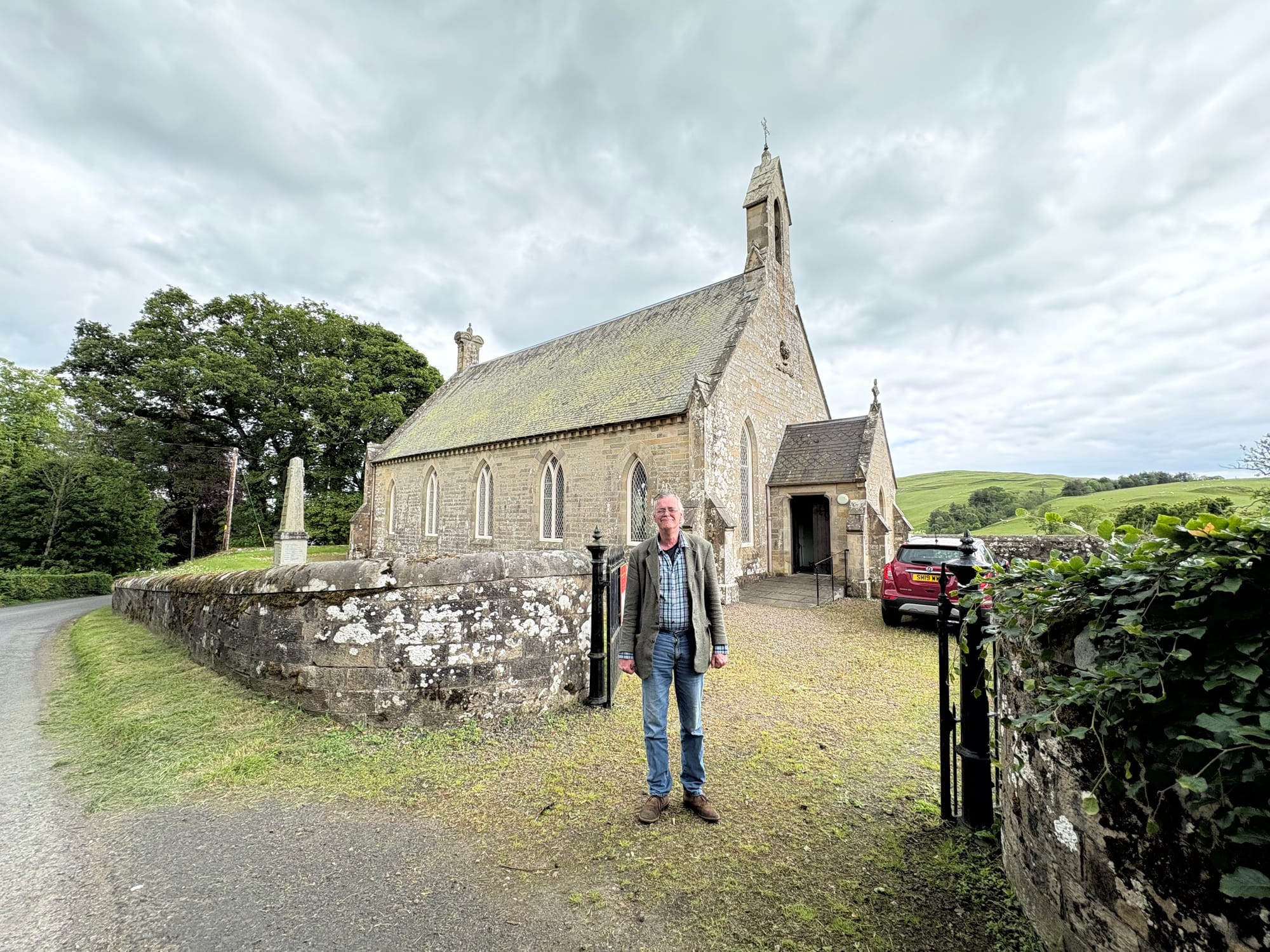
To step out of the church doors is to see the entire dilemma laid bare in a single frame. Outside, Charlie stands at the open iron gates beneath a heavy, textured Border sky that seems to mirror the sombre weight of the afternoon. Behind him, the stark geometry of the building rises from a clean gravel driveway—a visual testament to the lack of an encumbering graveyard, which makes its stones so valuable in the open market. To the left, a low stone wall separates the sanctuary from the roadside; to the right, the timeless, green ridges of the Borthwick Water rise toward the hills. Standing there, a solitary figure in tweed against the massive permanence of the stone, he embodies the very reality of the glen: a living community still rooted in the soil, watching the institutional tides recede from the places they have always called home.
As the valley prepares to gather for the harvest festival later this year, the fate of Roberton Kirk hangs in the balance between the ledger of the market, the pull of Hawick South, and the defiance of spirit—a community left to decide whether to yield to the six-mile horizon or to trust in a faith that defies the reality of their own empty pews. Yet, regardless of what the ledger eventually decides for these ancient stones, the final gathering remains an opportunity for a quiet word of thanks for the nine years of steady service, grace, and ministry that the Reverend Alistair Cooke has given to the Borthwick Water. In a landscape defined by deep roots and shifting horizons, he stepped into the long lineage of this parish with genuine humility and care. As he prepares to step down from the pulpit and lay down the keys of his ministry for a well-earned retirement, the enduring hope of the valley goes with him—asking that his next season be blessed with the very peace, rest, and abundance celebrated in the coming harvest, carrying forward the truth that a living faith is never truly bound by wood or walls, but survives in the community we keep and the paths we walk together.
Postscript
Note: After finalising this piece, I was eager to share it with Rev. Cooke and sent him a direct link to the article. His reply was brief, simply noting that if the church building is sold, services will continue in the Forman Hall.
This response perfectly proves the point of this entire investigation. It is a textbook institutional "wash-off"—an attempt to sanitise and flatten the radical, gritty history of the Borthwick Valley into a harmless logistical transaction.
To the institution, a church is just real estate, a problem to be solved by moving chairs into a multi-purpose community hall. They avoid talking about the deep ancestral commitment that built these walls because they know that history is a spark; if it were truly remembered, the community's commitment might be rekindled.
Trying to smooth over the loss of our heritage by calling it a minor administrative transition doesn't change what it actually is: the quiet erasure of our past.
The critique stands.