I. Introduction: The Spectacle of Rescue vs. The Reality of Nature
In the era of ubiquitous digital media, nature is increasingly mediated through the lens of human emotional consumption. A prime manifestation of this phenomenon is the online spectacle surrounding the rescue of "wild goats" on managed landscapes such as Langholm Moor. Viral videos capture well-meaning motorists stepping into the arena of the rut to separate large billies whose horns have become entangled during territorial combat.
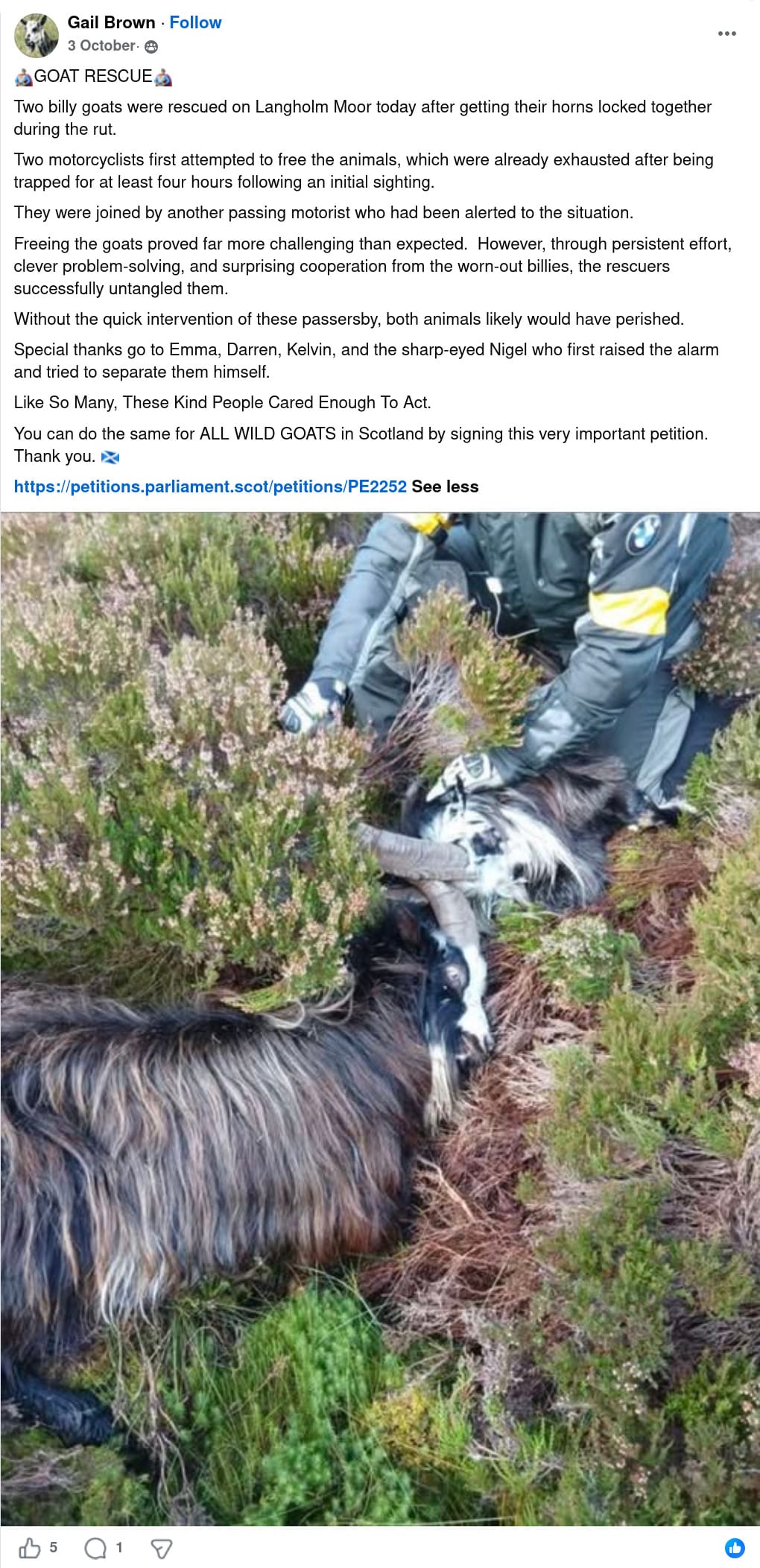
The immediate narrative framing is almost exclusively heroic: humans stepping in as benevolent arbiters to spare sentient beings from an agonising death. This sentimental framing rapidly translates into political action, driving public sympathy and formal efforts like Scottish Parliament petition PE2252, which seeks legal protections for these upland populations under the banner of preserving wild heritage.
Yet beneath this veneer of digital compassion lies a profound ecological and philosophical contradiction. When motorists untangle fighting billies or pull exhausted animals from natural hazards, they are engaging in a fundamental disruption of biological processes. This raises a central ethical paradox: Is saving individual animals from natural, evolutionarily dictated struggles an act of genuine moral care, or is it a form of ecological vandalism driven by human anxiety, anthropomorphic sentimentalism, and an inability to tolerate the unsentimental mechanics of the natural world?
II. The Ecological Fiction: Feral Descent vs. Ancient Wilderness
To evaluate the morality of intervention, one must first dismantle the linguistic and biological sleight of hand implicit in the term "wild goat." In the context of British ecology, true wild species—such as red deer (Cervus elaphus) or historically native wild boar (Sus scrofa)—possess ancient, unbroken lineages that co-evolved with the post-glacial landscape. These species adapted alongside native predators and flora over millennia, shaping and being shaped by their habitats in a complex web of mutual evolutionary pressure.
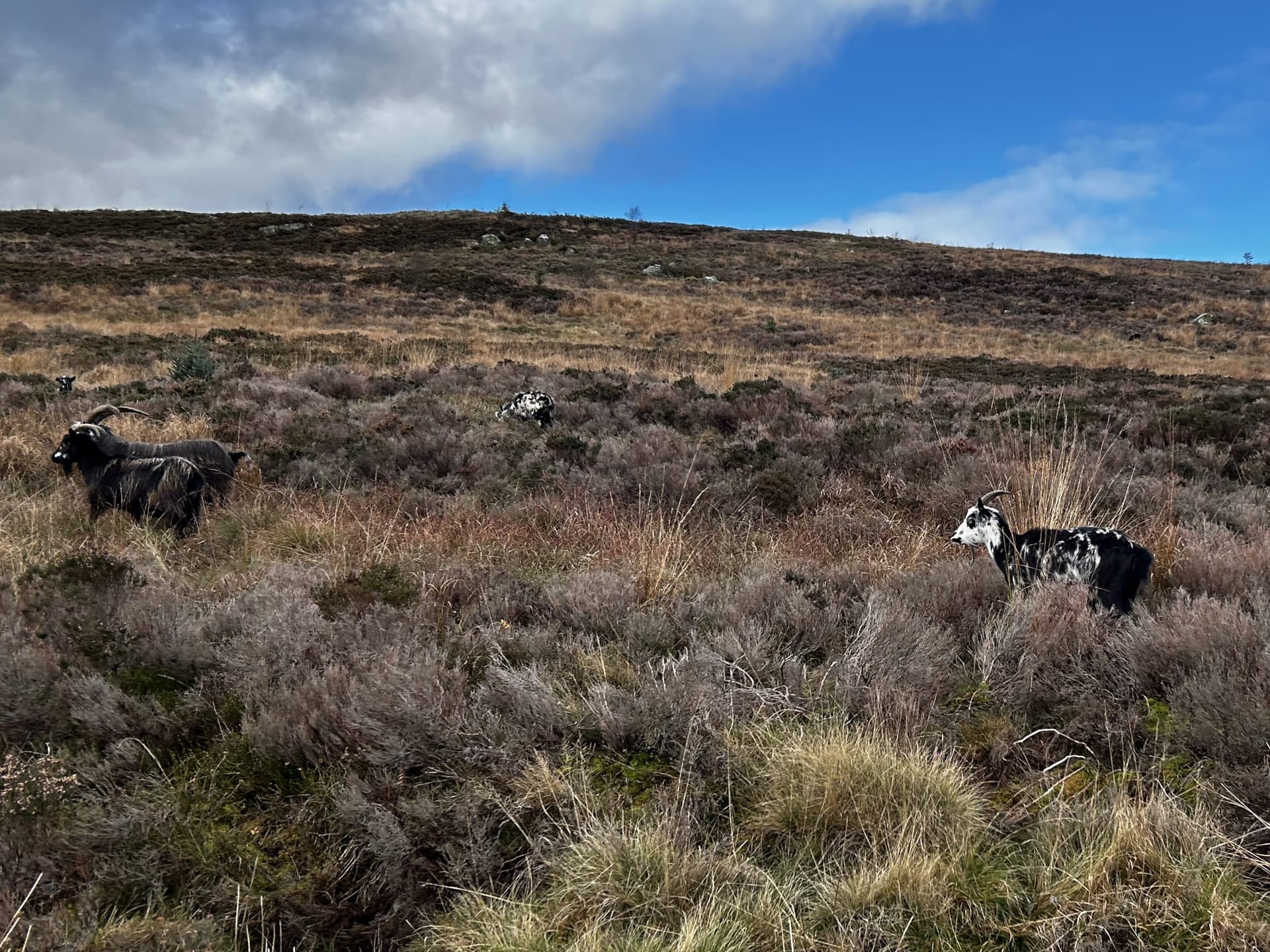
By contrast, the upland populations often romanticised as ancient "wild" herds are biologically feral livestock (Capra hircus). Their origins trace back not to primeval wilderness, but to agricultural settlements, subsistence farming, abandoned crofts during historical clearances, and accidental escapes. Placed upon heavily altered modern environments—such as upland moorlands managed intensively for driven grouse shooting—their existence is neither pristine nor ecologically autonomous. They are fundamentally managed feral stock operating under a romanticised banner of wildness.
By framing these feral populations as ancient, untouched entities, public discourse constructs an ecological fiction. This misattribution obscures the reality that these animals exist outside their native ecological niches, often exerting unmitigated grazing pressure on sensitive upland botany without the regulating force of apex predators.
III. The Utilitarian Calculus: Individual Pain vs. Population Resilience
The urge to intervene in animal suffering can be analysed through classical ethical frameworks, most notably the preference utilitarianism of Peter Singer. Applying Singer’s principle of the equal consideration of interests, a locked pair of billies faces severe, immediate physical agony, extreme exhaustion, and a slow, agonising death by starvation or predation. From a localised utilitarian perspective focused purely on the immediate minimisation of pain, human intervention appears unambiguously correct: the physical act of freeing the horns yields an immediate reduction in net suffering for those specific individuals.
However, extended consequentialist utilitarianism, coupled with evolutionary biology, reveals the hidden costs of this immediate empathy. In wild and feral populations alike, the rut is a primary mechanism of natural selection. The structural integrity of horn architecture, physical stamina, tactical restraint, and spatial awareness are critical traits tested during combat. Billies that become hopelessly entangled or succumb to exhaustion carry genetic traits or behavioural deficiencies that natural selection routinely prunes from the gene pool.
A useful parallel exists in domestic sheep husbandry. Generations of selective breeding for meat or wool yield have rendered domestic sheep vulnerable to conditions such as being "cast" (lying on their backs and unable to rise) or suffering chronic foot rot without human aid. When humans regularly intervene to rescue feral animals from biological friction, they initiate a similar trajectory. By systematically insulating vulnerable individuals from the fatal consequences of their own biology, we preserve and multiply maladaptive traits within the gene pool. Over generations, this short-circuiting of natural selection locks the population into a state of permanent human dependency, ultimately guaranteeing a far greater volume of systemic, multi-generational suffering.
IV. Anthropocentrism and Moral Licensing: The Domestication of Wildness
Hyper-intervention in animal life is fundamentally an act of anthropocentric projection. It forces human moral dispositions—specifically an aversion to physical trauma and death—onto a natural world operating on mechanisms utterly indifferent to human sentiment. This impulse treats living creatures not as autonomous agents navigating an unmerciful environment, but as proxy objects designed to fulfil a human desire for moral agency, utility, and control.
To argue that rescuing animals from natural friction is destructive is to recognise that stripping away the natural consequences of wild existence is itself a subtle form of habitat and species degradation. When human intervention dictates which individuals survive the rut, which animals survive terrain hazards, and how populations reproduce, the essential quality of "wildness" is erased. The landscape is effectively converted into an unmanaged zoo, and the animals are reduced to props in a staging ground for human conscience. This moral licensing allows spectators to feel ethically fulfilled while accelerating the conceptual domestication of the natural landscape.
A striking historical parallel illustrating this dynamic is found in the famous Chillingham white cattle. Popularly romanticised as living relics of ancient, primeval wild oxen, the Chillingham herd is in reality an enclosed, highly inbred remnant of medieval park livestock. Their existence was engineered entirely for aristocratic recreation, bloodsport, and vexation within enclosed estates, rather than as autonomous survival in an untamed wilderness. Utilising the label "wild" for such populations serves a key psychological function: it projects a romanticised fantasy of pristine nature onto animals that are, in truth, the direct products of historical human enclosure and utility.
VI. The Displacement of Human Alienation
Hyper-intervention and sentimental rescue culture ultimately reflect a deeper psychological displacement within modern society. As human existence becomes increasingly atomised, bureaucratised, and stripped of genuine communal solidarity, individuals experience profound detachment from human empathy and struggle to establish meaningful connections with one another. Consequently, this unfulfilled need for mutual care and belonging is redirected outward onto non-human animals and an idealised projection of nature. Animals serve as safe, uncomplicated canvases for moral purpose; unlike human companions, they do not disappoint, harbour conflicting motives, or complicate relationships with moral flaws, and their physical suffering appears immediate, legible, and unambiguous.
In this context, stepping onto a moor to liberate a trapped animal yields a clean, instant sensation of moral clarity and immediate validation across digital communities. This performance of empathy provides a sense of heroic virtue without requiring the arduous, ongoing, and emotionally complex labour needed to navigate human suffering or repair systemic social breakdown. Ultimately, by projecting our desperate longing for pure, uncorrupted compassion onto wild creatures that remain entirely indifferent to human emotional needs, we grant ourselves permission to flee from the exhausting demands of genuine human community.
V. Conclusion: Accepting the Harsh Calculus of the Wild
A genuine, robust ethical engagement with the wild requires a willingness to confront and accept its intrinsic harshness—including struggle, injury, and death. Pain and mortality are not system errors within nature; they are the fundamental engines of adaptation, vitality, and evolutionary integrity.
When humans refuse to allow nature to run its course, the primary beneficiary is rarely the species as a whole. More often, intervention serves to shield the human observer from the psychological discomfort of witnessing unvarnished biological reality. True ecological stewardship demands the discipline to step back. It calls for the recognition that the natural world does not owe human sensibility a comfortable or harmonious aesthetic, and that true respect for autonomy means allowing wild systems and feral populations to endure the consequences of their own existence.
Footnotes
- On the psychological displacement of community atomisation and the projection of uncorrupted empathy onto non-human agents, see generally Erich Fromm, The Escape from Freedom (Rinehart & Company, 1941), regarding the flight from the burdens of individual autonomy into manufactured conformity and proxy attachments.
- For an examination of how modern technological and media mediation sanitises natural realities into passive emotional spectacles for consumer consumption, consult Guy Debord, The Society of the Spectacle (Zone Books, 1994).