
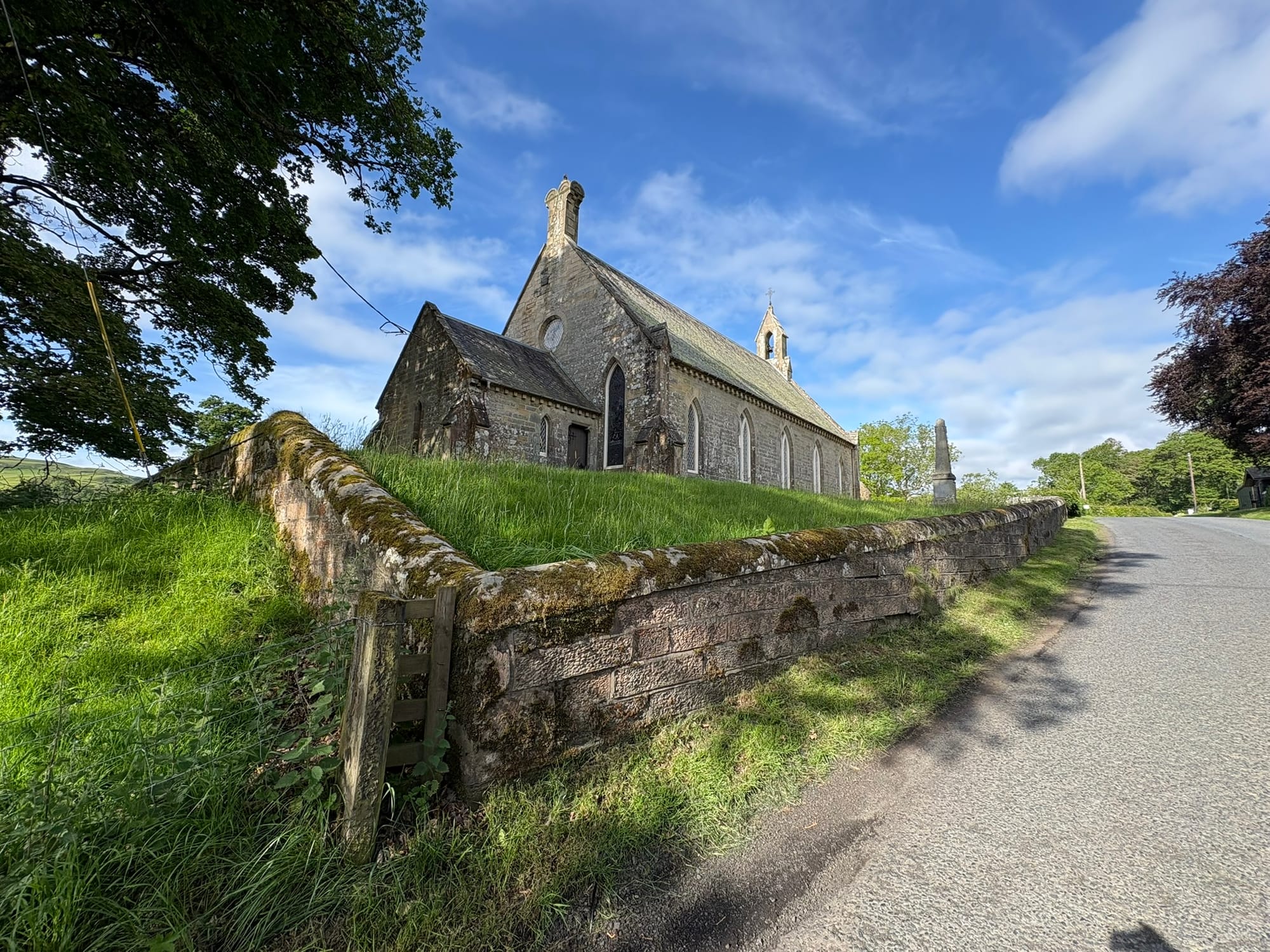
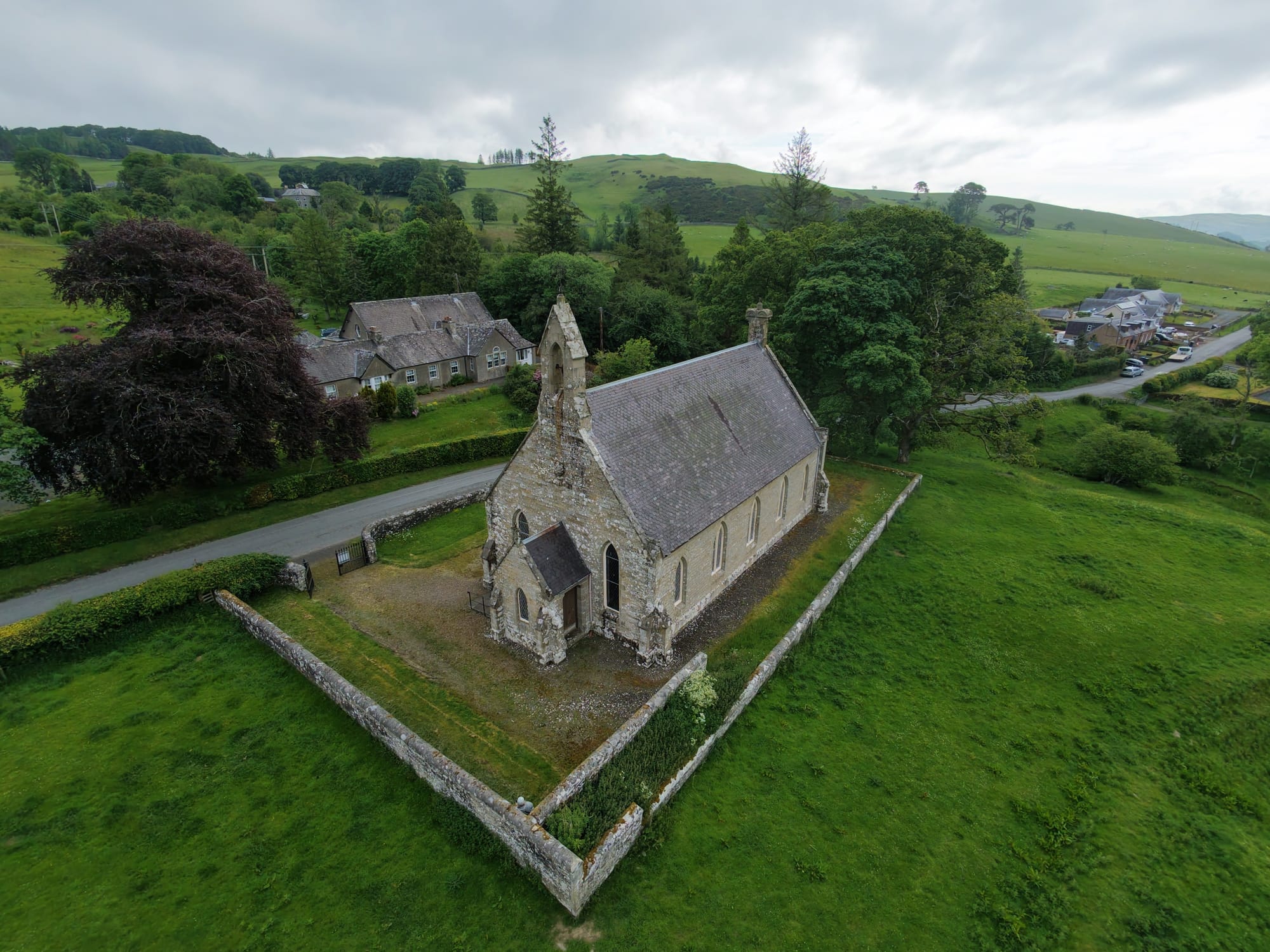
Today, the Borthwick Valley is caught in a quiet tug-of-war between the pressures of the modern world and the resilient spirit of its people. To look across these hills is to see a landscape under change: huge corporate wind farms are proposed for the ridges, the historic parish church has recently closed its doors, and thick, dark blocks of commercial forestry have systematically swallowed the hillsides, sometimes flattening old ancestral cottages to make way for timber plantations.
Yet, beneath this quiet pressure, the community remains stubbornly alive inside the Forman Memorial Hall. Here, neighbours from all walks of life—both those whose families have been rooted in this soil for generations and newcomers who have recently chosen to make these hills their home—gather to keep local life vibrant. Whether it is the quiet concentration of a Thursday night yoga class, the friendly competitive banter over the steady click of Monday night carpet bowls, or the shared warmth of community quizzes, cream teas, and live music, the hall stands as the valley's true anchor.
In creative writing, a storyteller always starts from another story. The people who lived in this valley before left behind a deep, rich opening chapter written into the land. The life continuing here today isn’t just about preserving the past; it is about giving everyone who arrives a meaningful foundation to build upon as they write the next chapters of their own lives.
The Footprints in the Grass
To understand the valley today, we have to look beneath the surface. Where commercial forestry vehicles now drive, generations of tenant farmers, shepherds, and labourers once raised their families, completely tied to the demanding seasons of the hills. Stepping through the gates of Roberton Kirkyard brings us face-to-face with that passing time. The busy pace of the outer world drops away, replaced by the heavy presence of weathered stone and creeping moss. On the oldest markers, hand-carved skulls, crossbones, and hourglasses offer a stark memento mori—an ancient, visual reminder that all life eventually turns to dust.
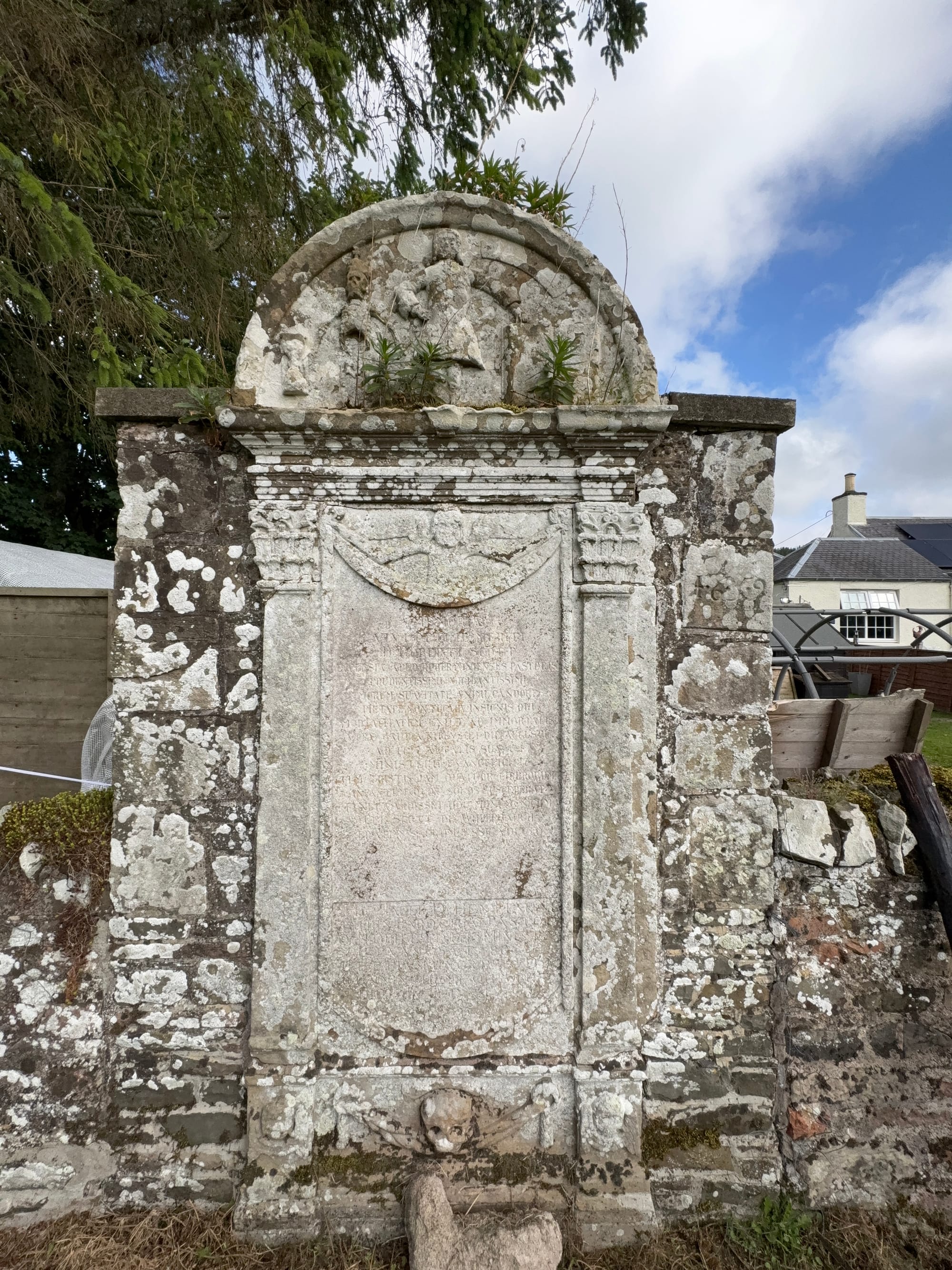
The cemetery is a detailed map of the valley's old social ladder. Grand, towering monuments proudly display the lasting power of wealthy landowning families, while the simplest, small markers at the edges record the nameless shepherds and labourers whose hands physically worked the soil and kept the parish running.
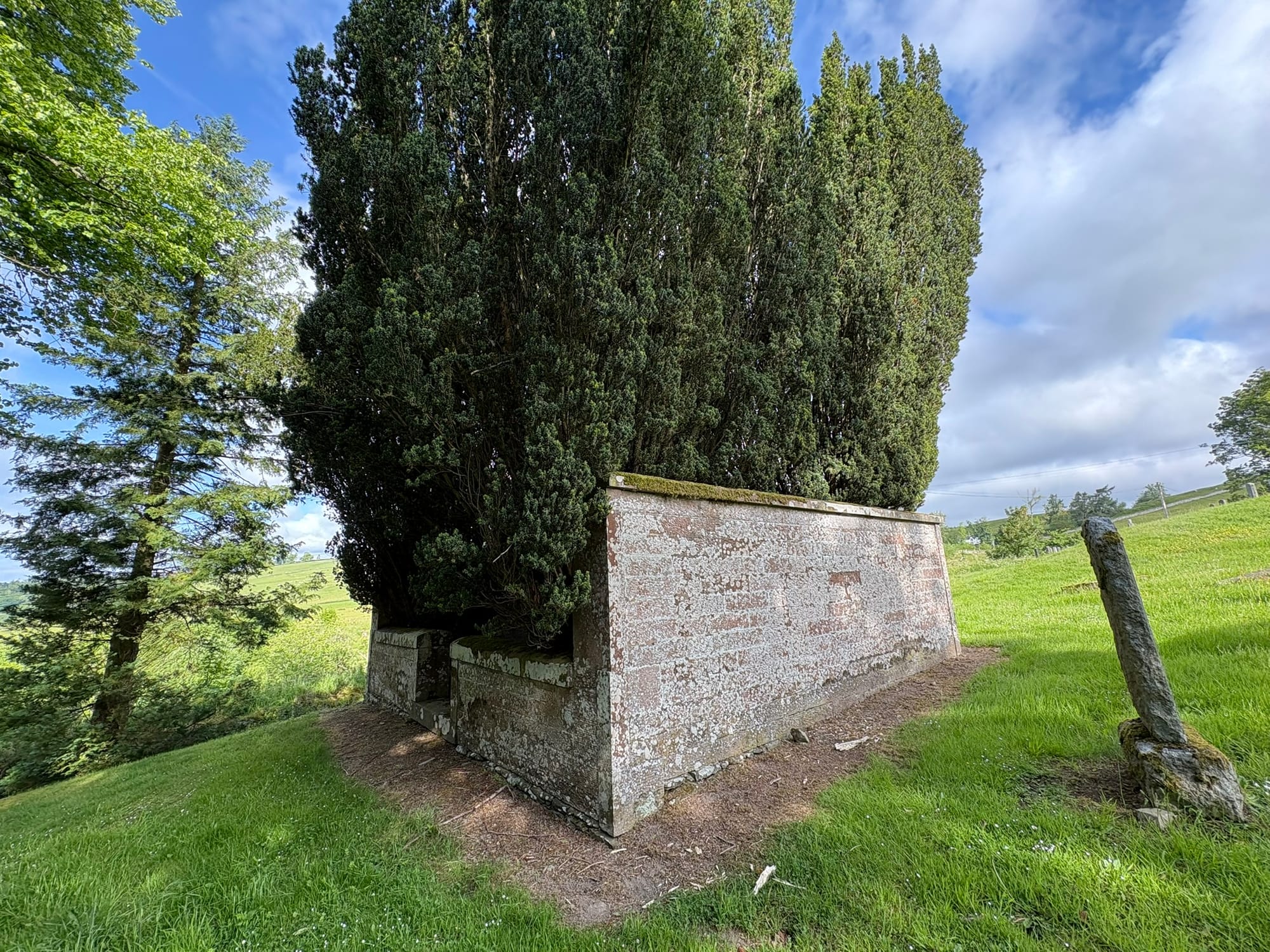
This social structure takes an explicit, walled-off form inside the shadowed burial enclosure of the Scott of Howcleuch family. As heritors of the parish, the Scotts held the immense civic responsibility for the structural upkeep of the entire church building. Their family plot sits surrounded by high stone walls and guarded by four massive yew trees planted at the corners, creating a clear visual boundary between themselves and the rest of the congregation.
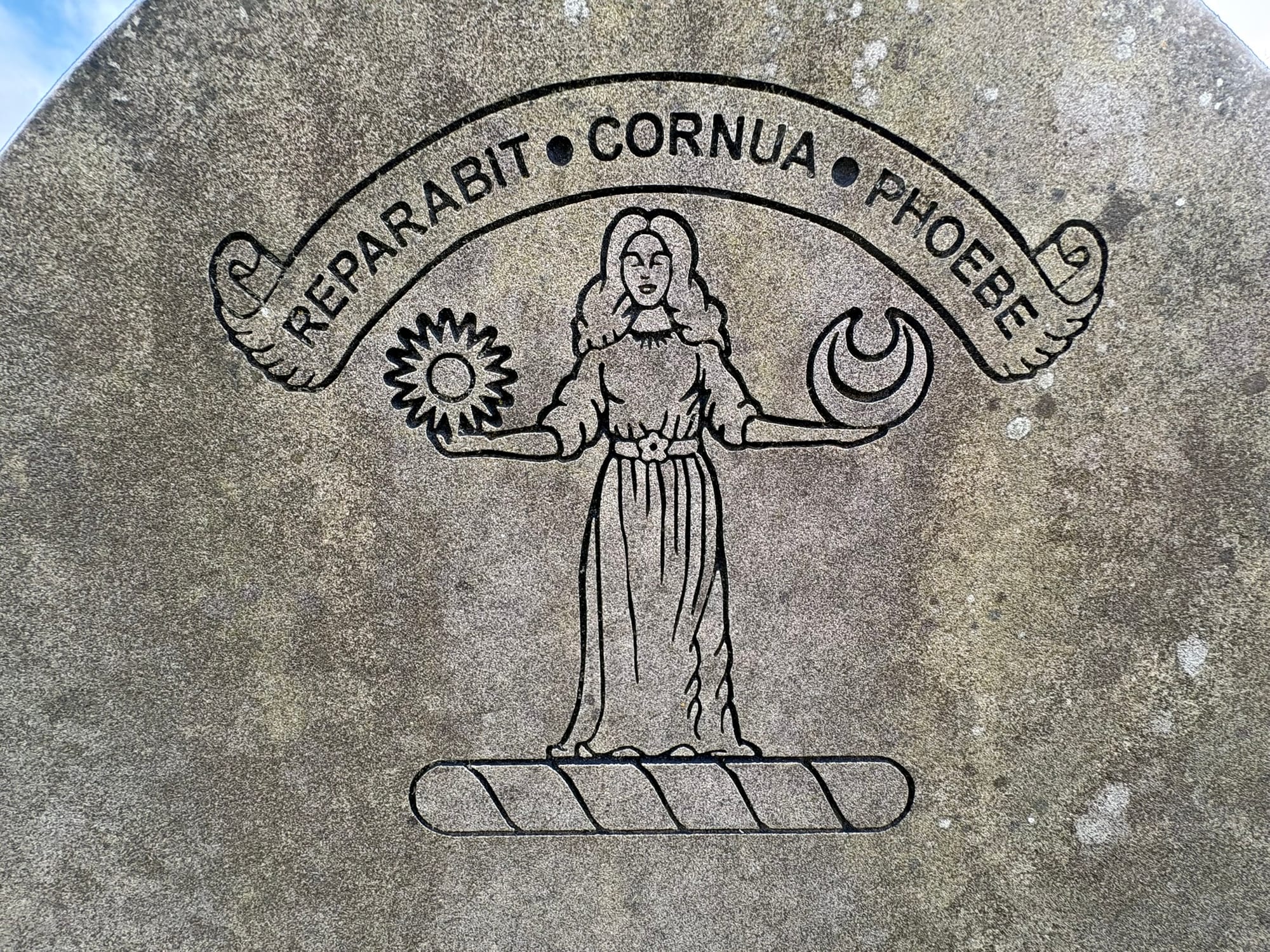
Inside the enclosure, the stone heraldry remains sharply detailed, featuring their proud coat of arms and the ancestral motto REPARABIT CORNUA PHOEBE ("The moon shall fill her horns again")—a historical nod to the midnight cattle raids of the old Border Reivers. Yet the elements carry out a quiet levelling here, too; despite the high defensive walls meant to preserve their memory, the individual names and dates on their central stone panel have been deeply weathered by time, showing that even the valley's historic heritors eventually share the same silent anonymity as the fields they once ruled.
Landowners, Teachers, and the Families Who Left
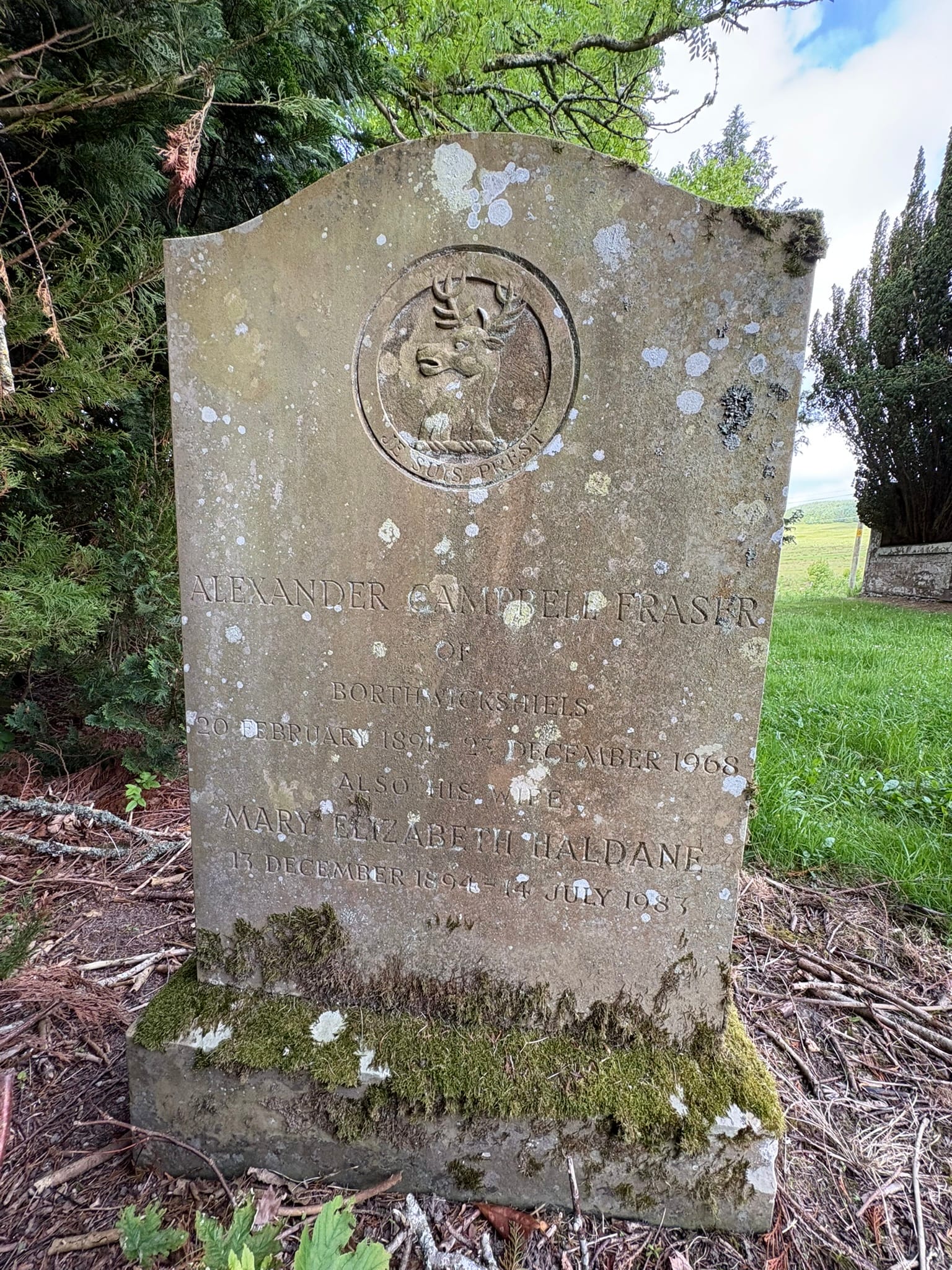
Yet a closer look shows that the land eventually treats everyone equally. Along the shaded perimeter beneath the pines stands the sandstone marker of Alexander Campbell Fraser of Borthwickshiels and his wife, Mary Elizabeth Haldane. Even though his family held immense aristocratic power over the local estates, this twentieth-century laird chose to be buried flat in the open, common ground alongside his tenants. Today, thick green moss climbs over his ancestral stag crest, turning an old emblem of status into a living part of the forest floor.
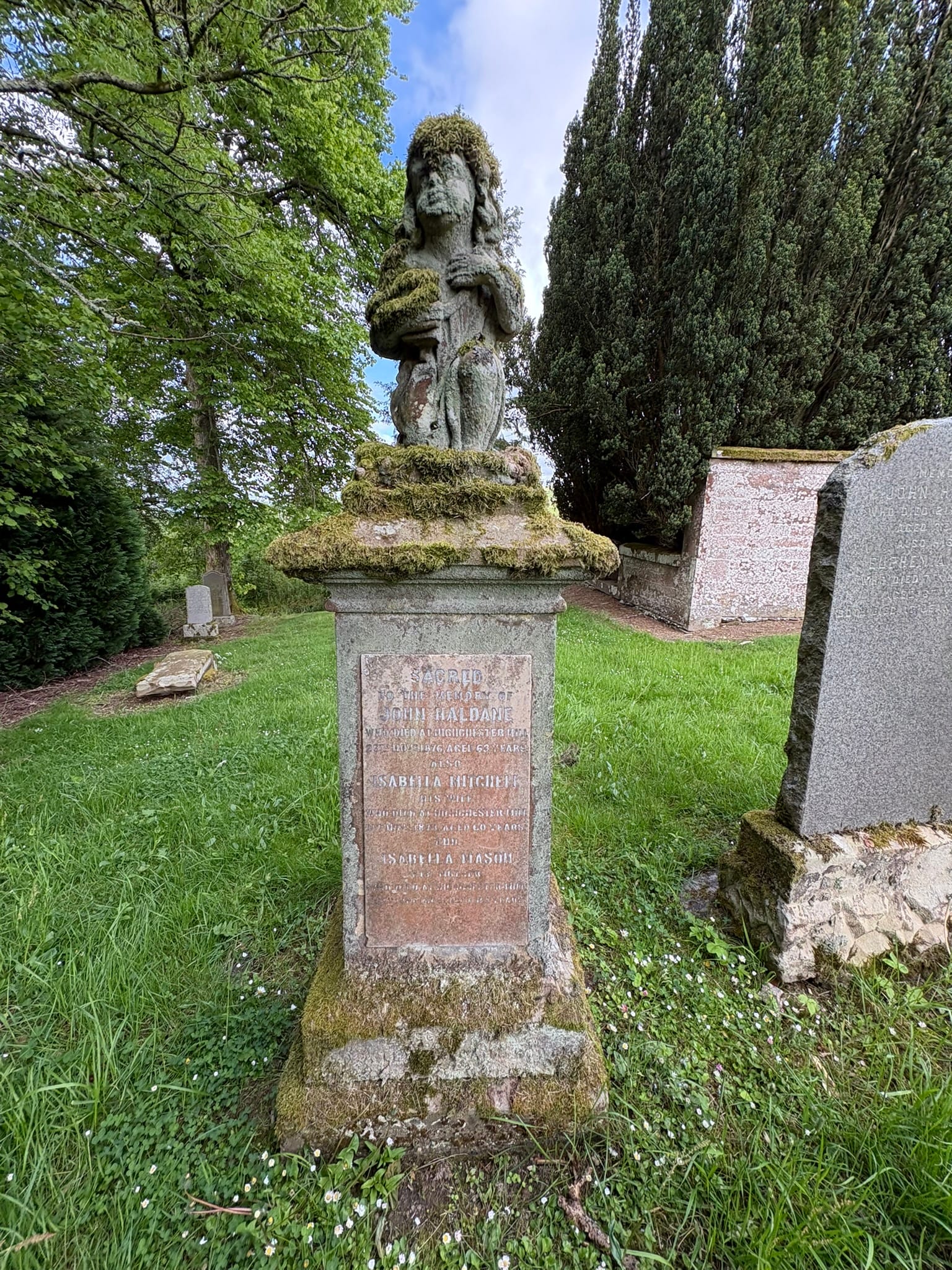
This local soil also connects the valley to the wider world. Nearby in stands a beautiful sandstone pedestal topped by a kneeling statue, marking John Haldane, who died thousands of miles away in Chichester, USA, in 1876. Though hard economic times forced him to cross the Atlantic for work, the gravity of home pulled his memory back to the parish yard. Sharing a surname with the laird’s wife, his stone shows how families split and spread—one branch running the grandest estate in the valley, another travelling across oceans, but both finally meeting back in the exact same turf. Today, a soft cap of emerald moss grows over the statue's head like a velvet cushion, showing that the valley eventually gathers all its children back home.
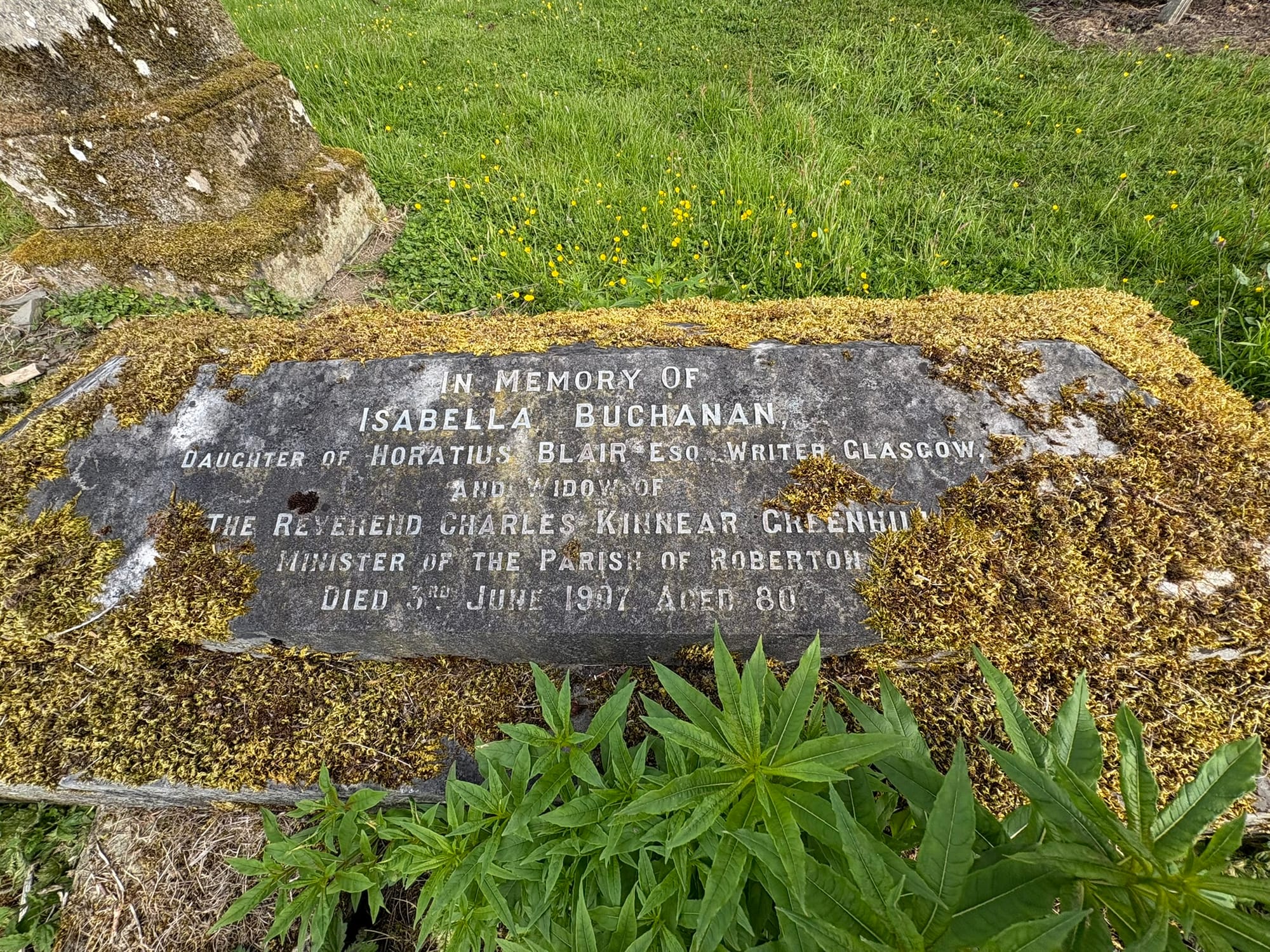
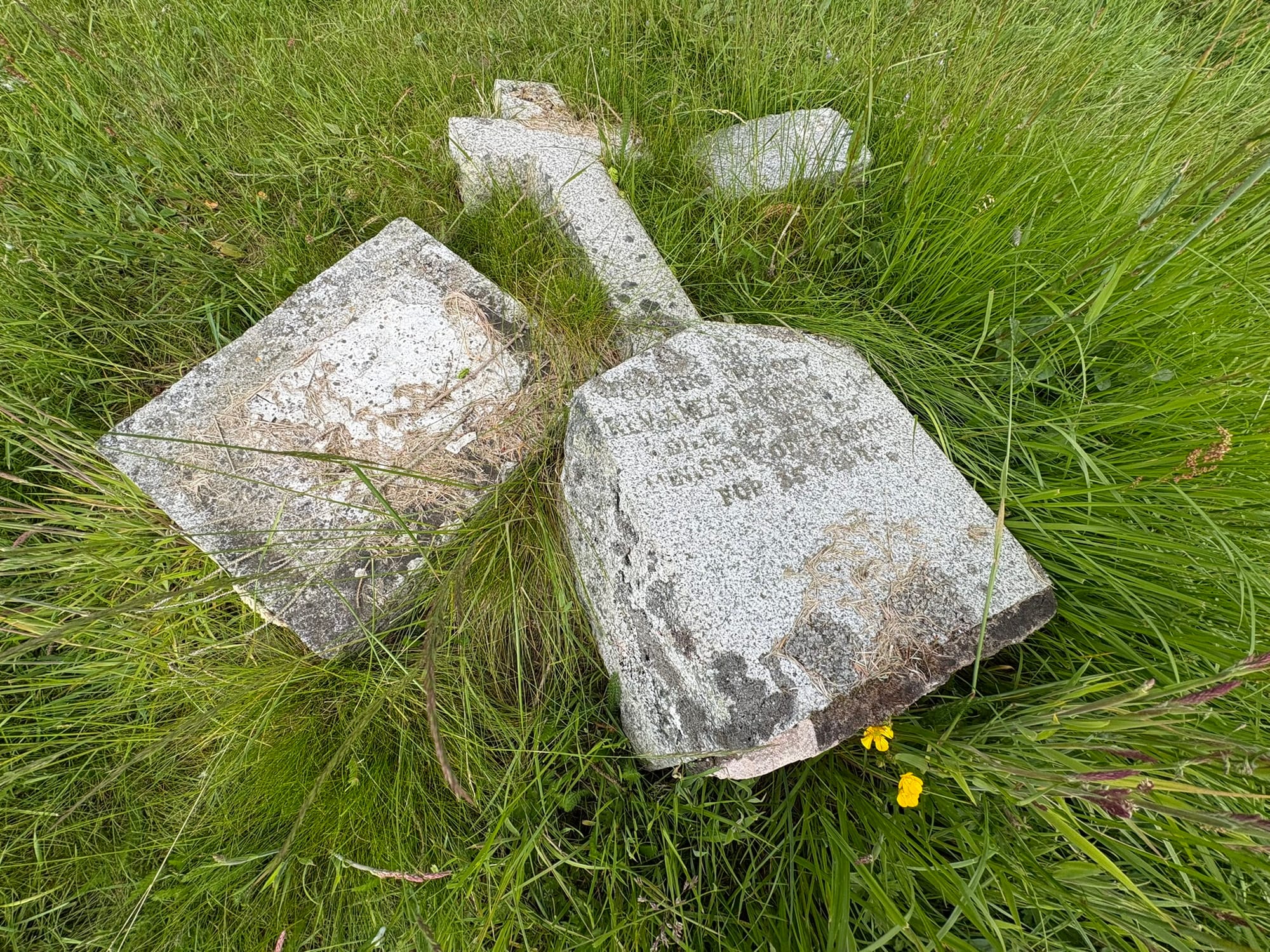
The old authorities of the parish have also stepped down into the grass. A dark, flat stone slab framed by golden moss in marks Isabella Buchanan, a lawyer's daughter from the big city of Glasgow who came to these quiet hills as a minister's wife. By lying flat from the very beginning, her stone has escaped the fractures of time, reminding us that the valley was always a team effort between native families and those who moved in from the outside. In sharp contrast, a massive granite cross nearby in has snapped completely at its base, toppling flat into the high turf. The inscription belongs to the Reverend R. Spark, minister of Roberton for 35 years. In his day, the minister was the ultimate anchor of the community. Now, just as the church doors have closed, his vertical monument has broken and returned to the level of the soil, with bright yellow buttercups blooming directly out of the cracked stone.
A Century of Education
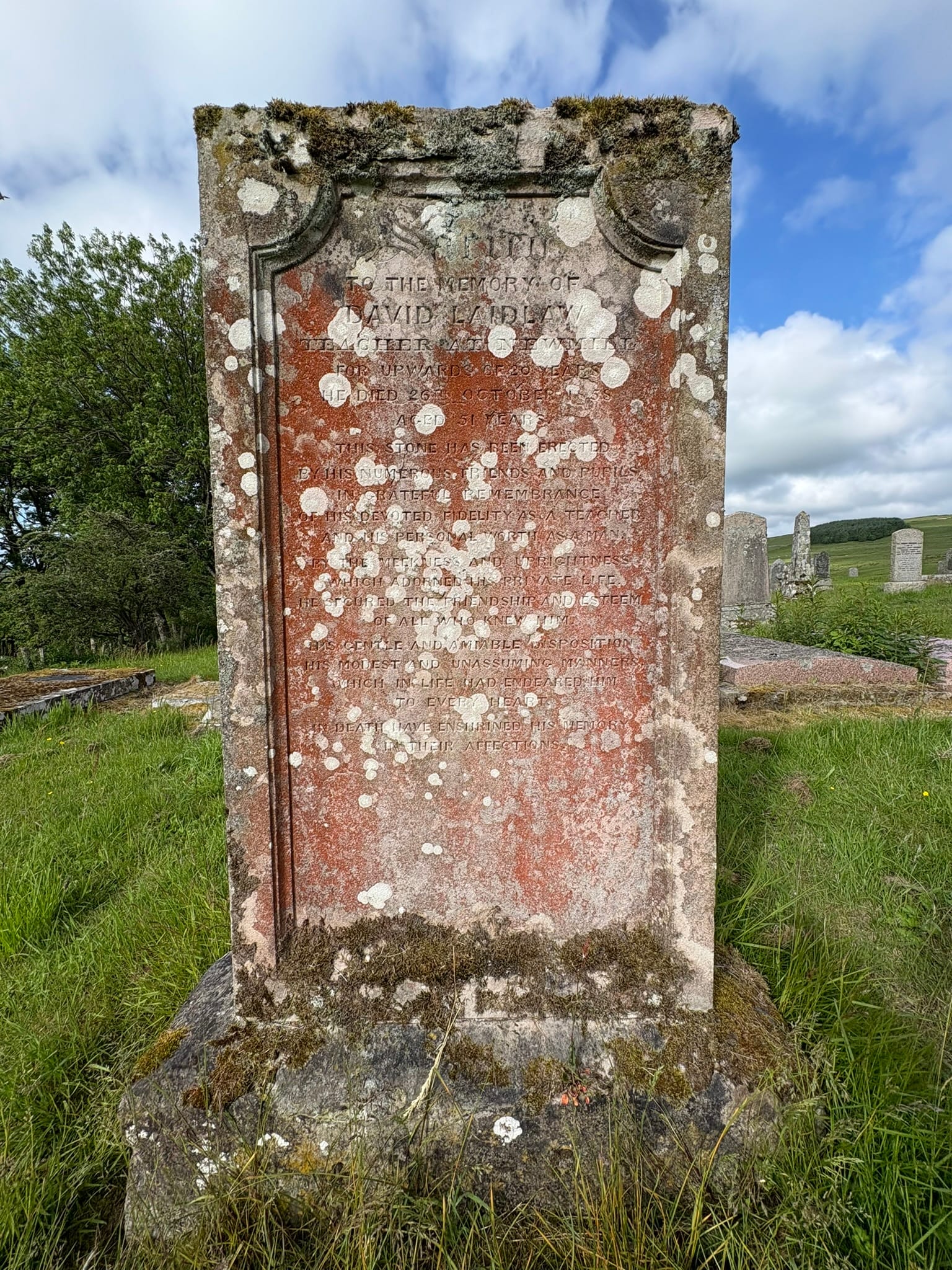
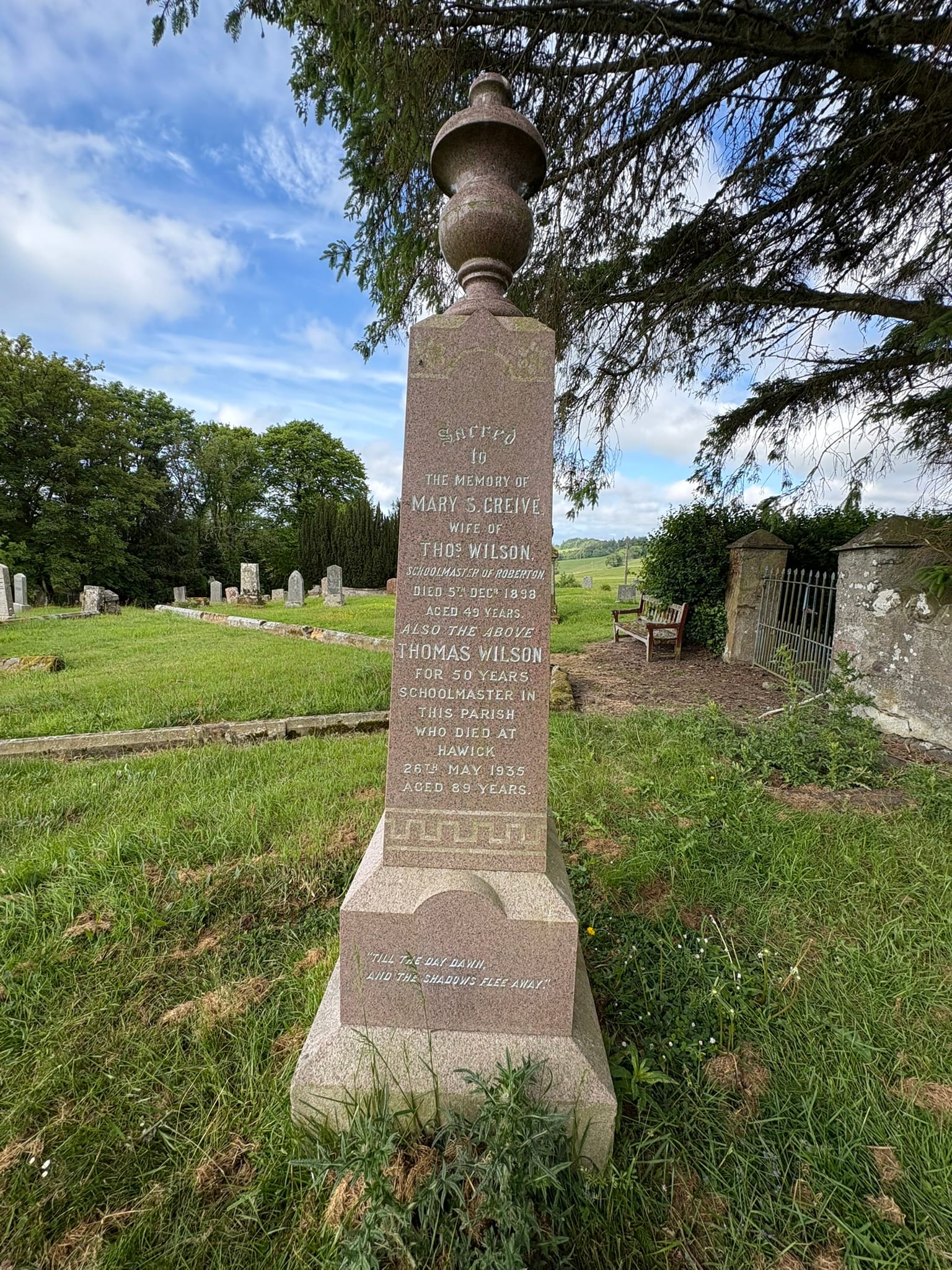
The anchors of the valley's intellect rest close by. A large red sandstone monument covered in white circular lichens honours David Laidlaw, a teacher at Newmill for over twenty years. Crucially, this stone wasn't paid for by a wealthy estate, but was funded collectively by his "various friends and pupils" who pooled their pennies in gratitude. Right near the entry gates stands a polished pink granite obelisk for Thomas Wilson, who served as the schoolmaster here for an incredible 50 years. These teachers were the true builders of the community, educating the children of wealthy farmers and poor labourers side-by-side in the same room.
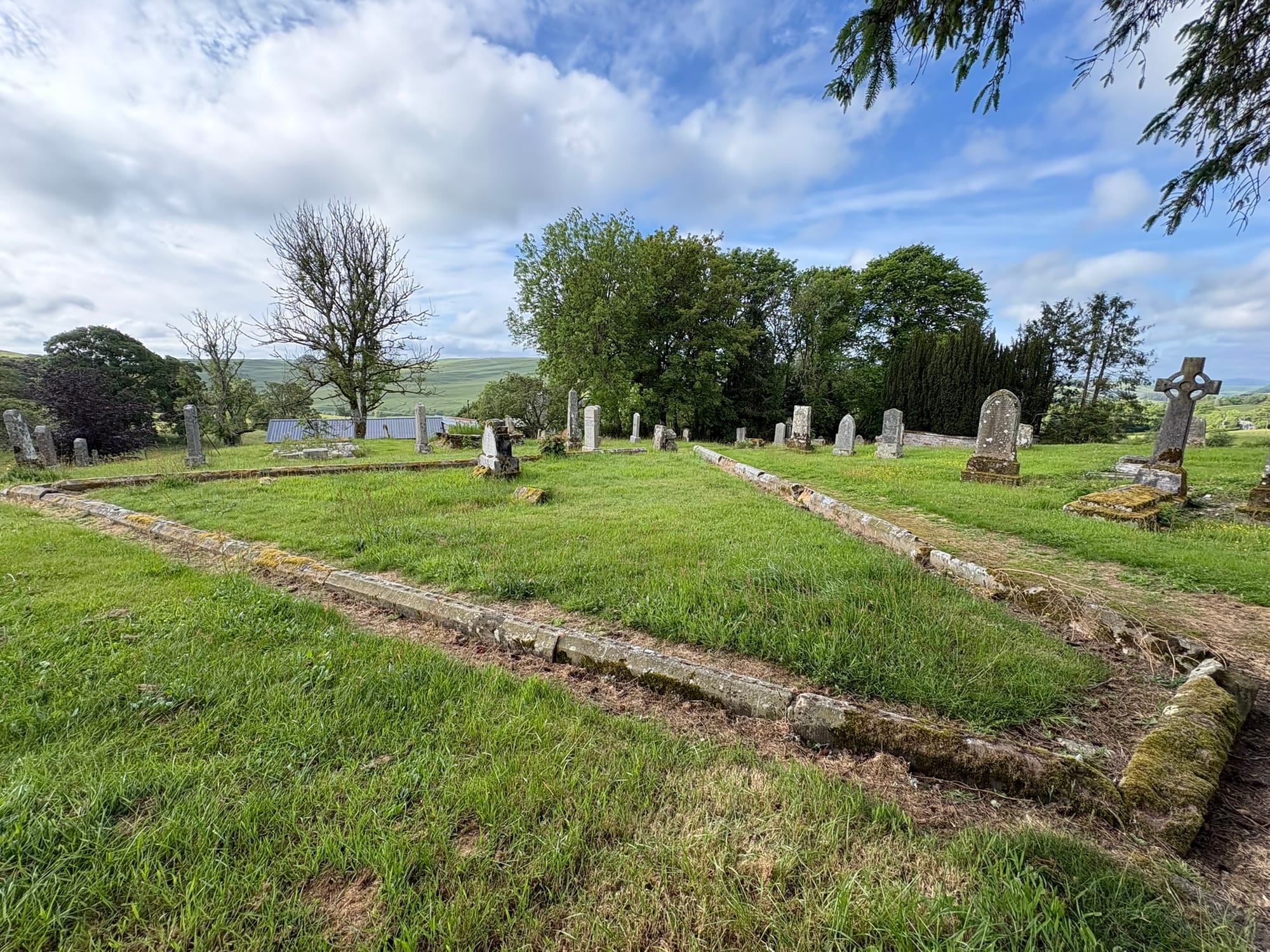
This proud history highlights a deep modern loss: Roberton once had its own dedicated primary school to look after its children, but it has long since been closed and centralised elsewhere. This modern retreat makes the silent stone triangle traced into the turf nearby feels even more significant. These low, mossy foundations mark the footprint of an earlier incarnation of the parish church, dismantled long ago. The building has completely cleared the stage, leaving an open common green that frames the distant, rolling pastures we look at today.
Taken Back by Nature
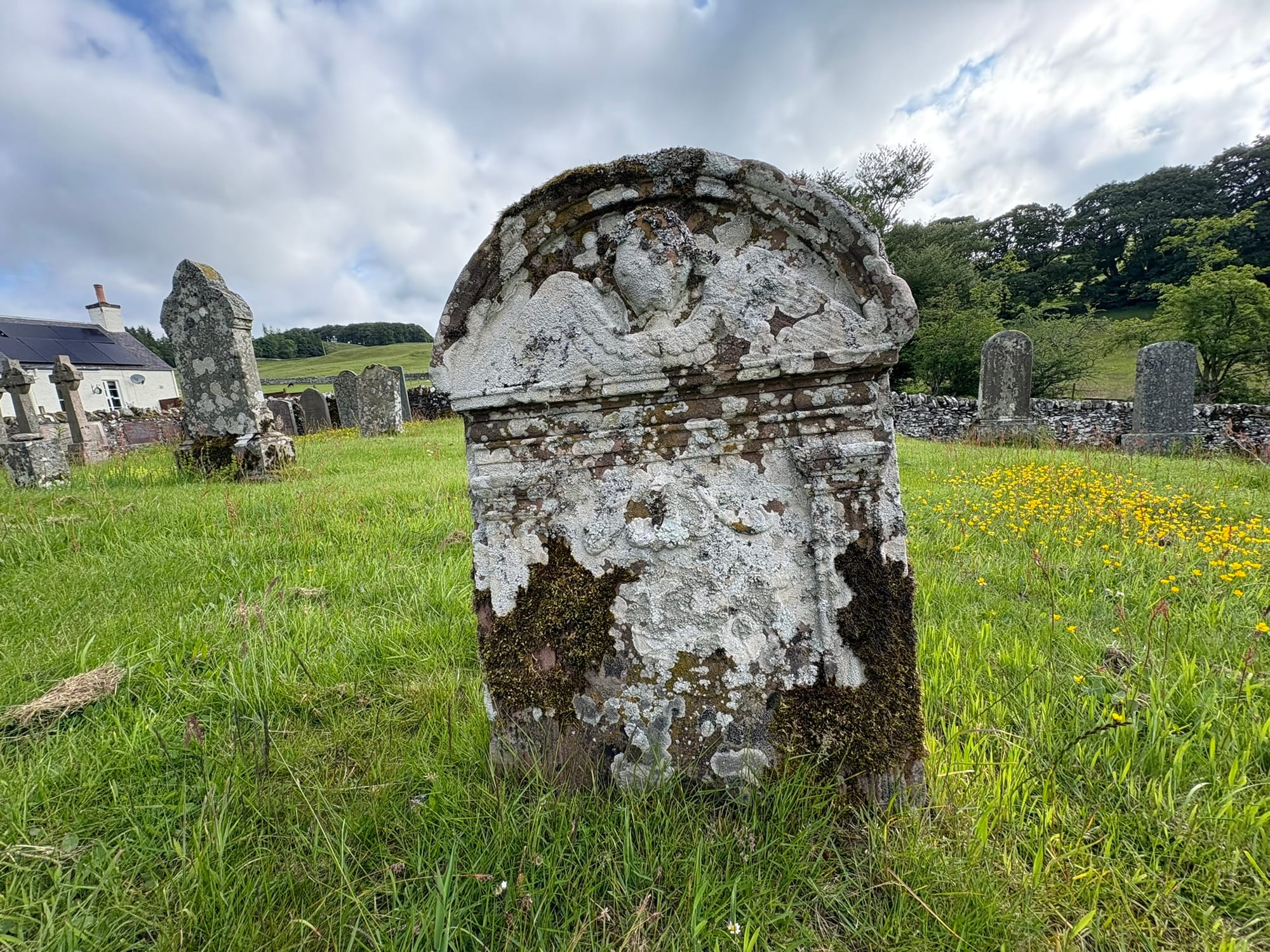
In the middle of the yard, the cemetery offers its most peaceful lesson. A solitary sandstone marker has completed its transition into pure nature. Its carved angel has weathered into a smooth, faceless oval, and a dense crust of white lichen has completely filled in and erased every single written name and date. Yet, this completely anonymous stone stands right in front of the active, modern valley—framed beautifully by a contemporary cottage with solar panels on one side and a vibrant field of yellow wildflowers on the other.
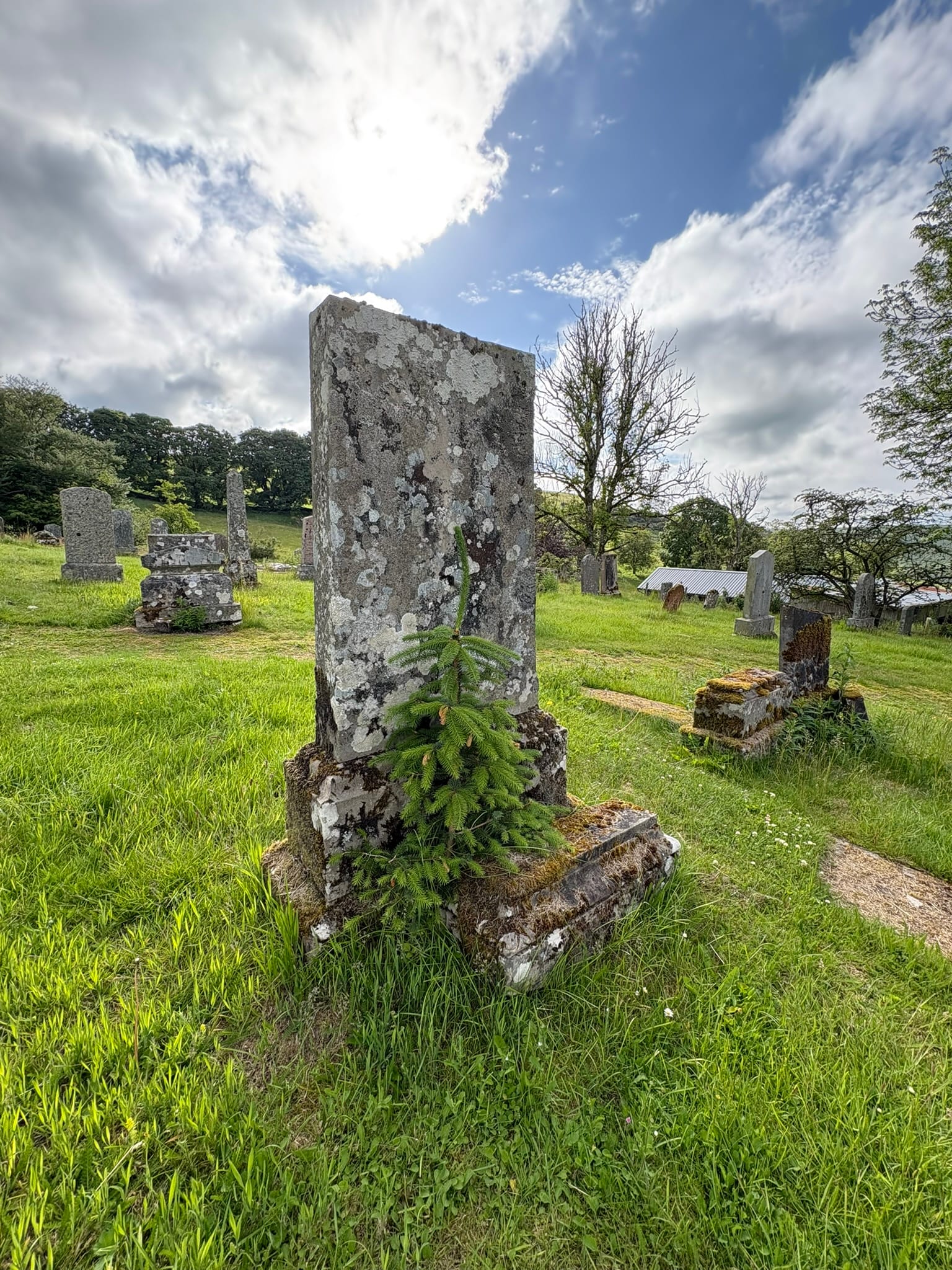
In a striking, ironic twist, the modern timber industry has physically breached the cemetery walls. Sprouting straight out of the stone joints of an anonymous grey monument is a small, perfectly formed Sitka spruce tree. A single rogue seed from the commercial plantations outside has drifted over the wall on the wind, finding a home in the crumbling mortar of an ancestor's grave. The tree is thriving directly on the foundation of mortality—a vivid reminder that the landscape will always break down our static stone monuments and use them to nurse new, green life.
The Roof Over Our Heads
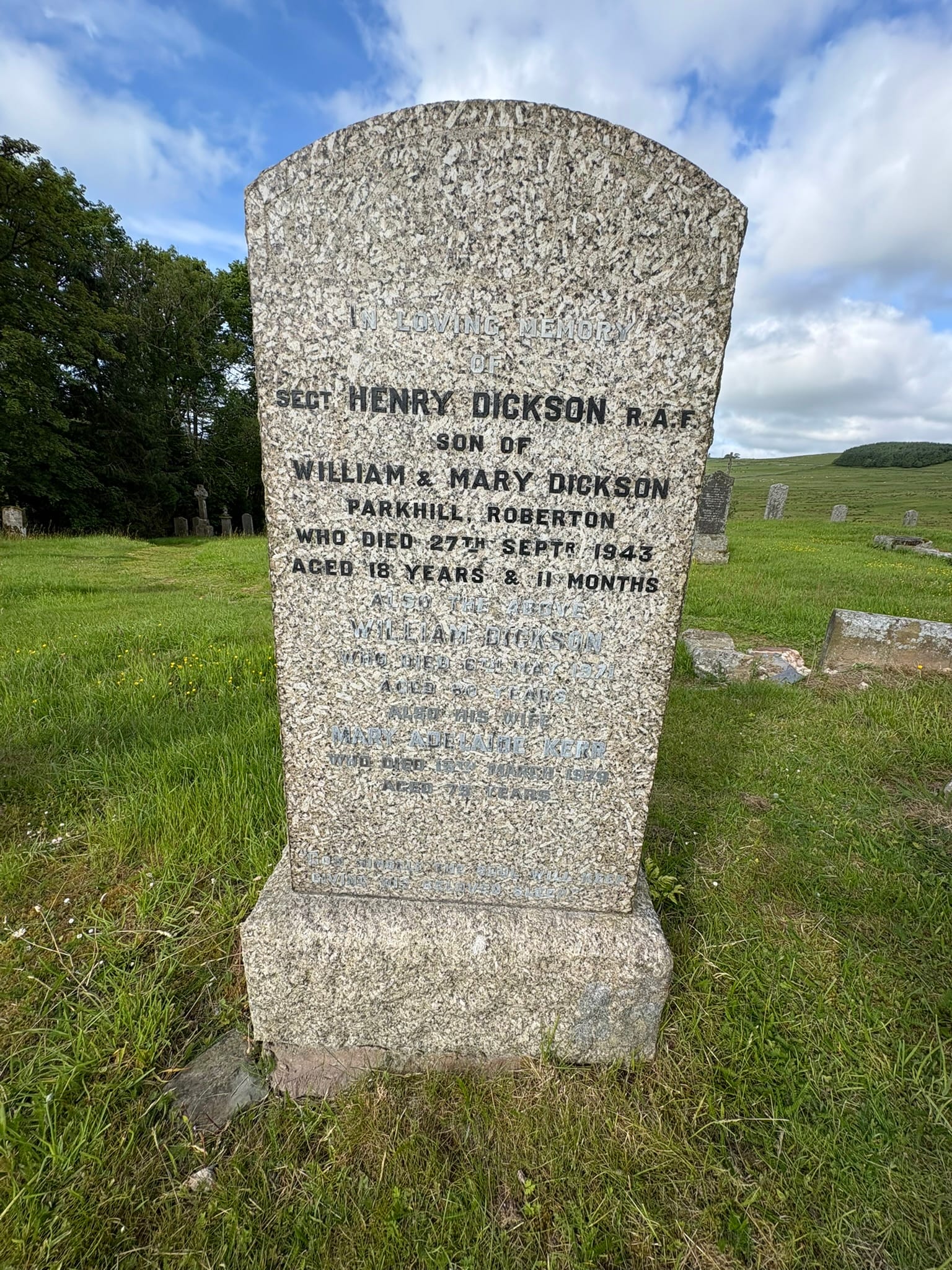
This continuous bond changes dramatically when you confront the crisp granite stone of Sergeant Henry Dickson, an RAF airman from Parkhill Farm who died in the autumn of 1943 at just 18 years old. Global warfare did not respect the isolation of these hills, claiming the valley's youth before their lives could truly begin. His dark, legible lettering stands out against the calm, green pastures of his home, reminding us of the connection the modern community has to the youngsters who came before them.
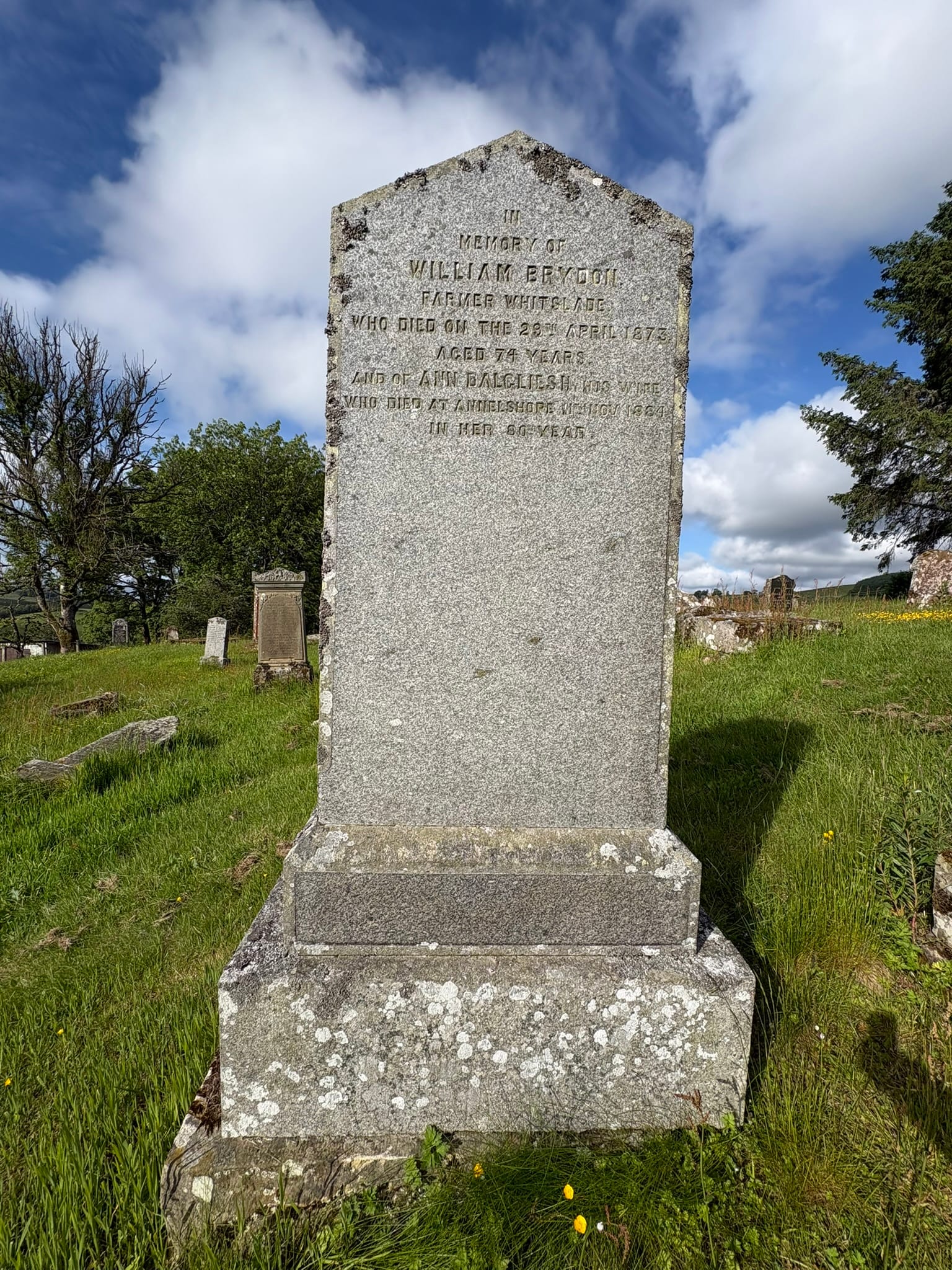
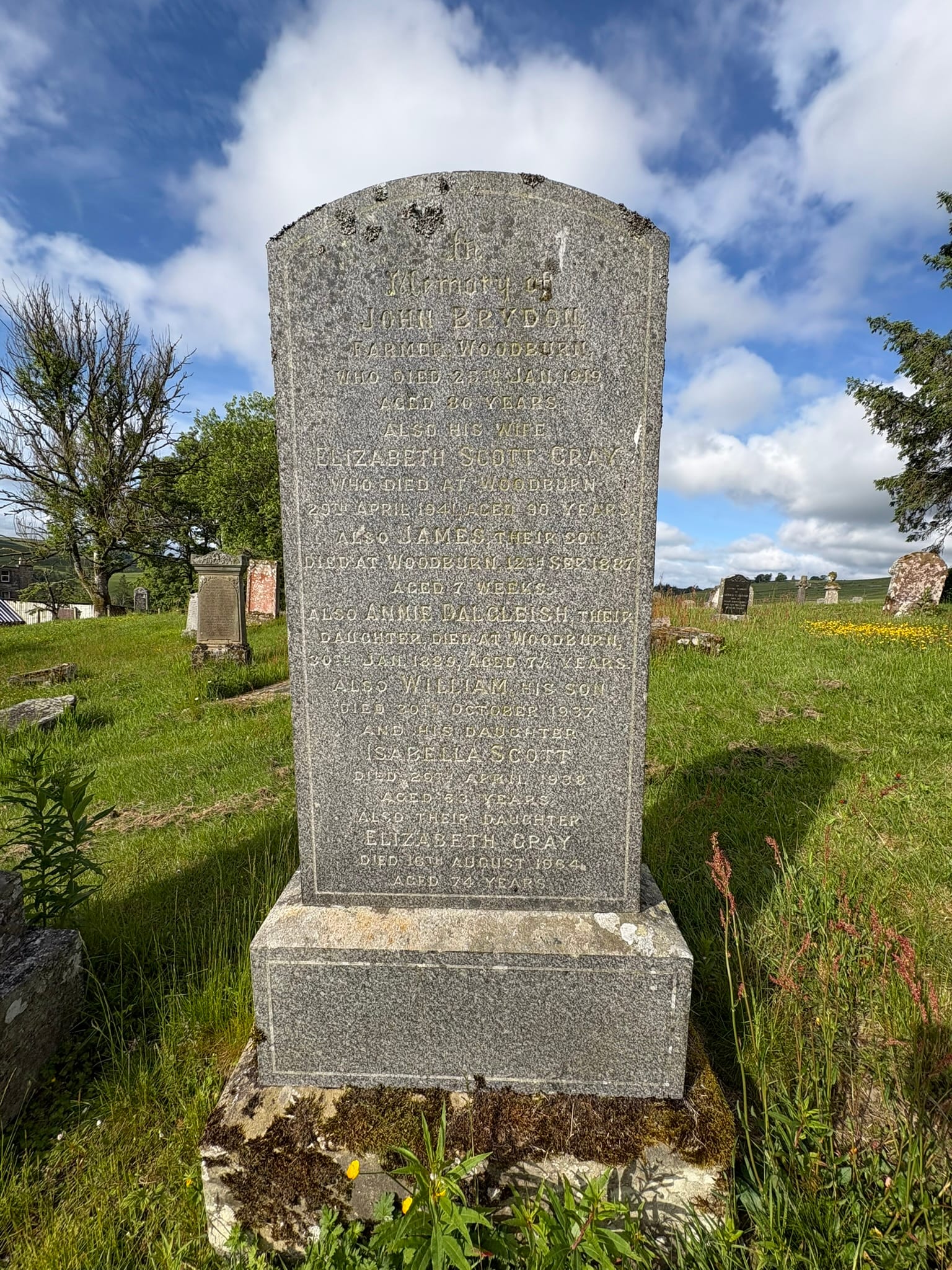
The line between history and daily life disappears completely when you find the graves of the Brydon family. A pristine pair of grey granite headstones records William Brydon of Whitslade and his son John Brydon, farmer of Woodburn , alongside his wife Elizabeth and the little infants they tragically lost to the harsh winter damp in the late 1800s. This is the exact roof under which life in the valley continues today. The rooms where people now sleep and find warm shelter were once the emotional heart of this farming dynasty. With the modern threat of industrial wind turbines looming directly over the ridges of Woodburn, these stones transition the observer from looking at history to looking at the present. The Brydons worked these fields and weathered these storms; living inside their rooms connects the current residents directly to that line.
The True Memorial
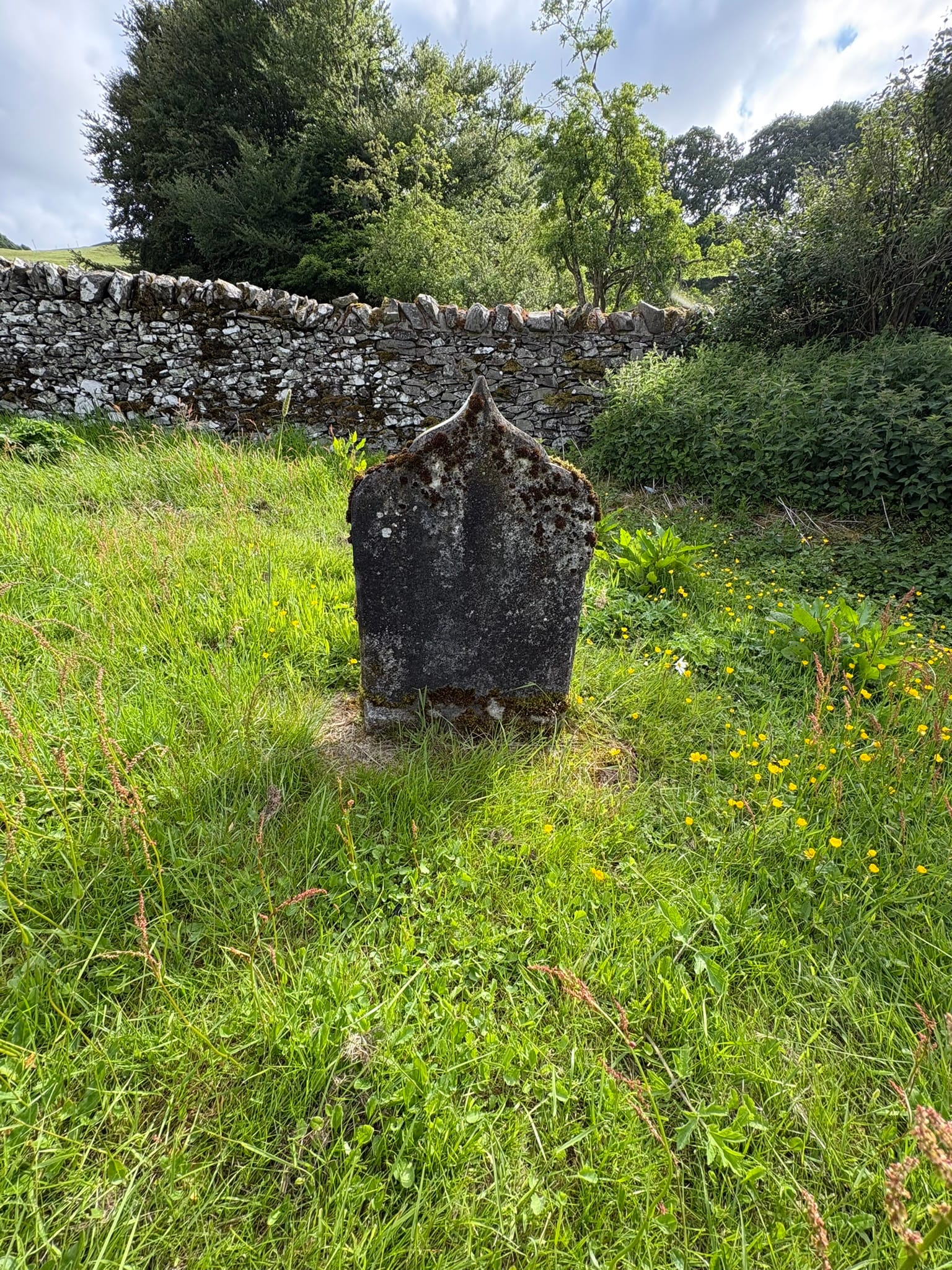
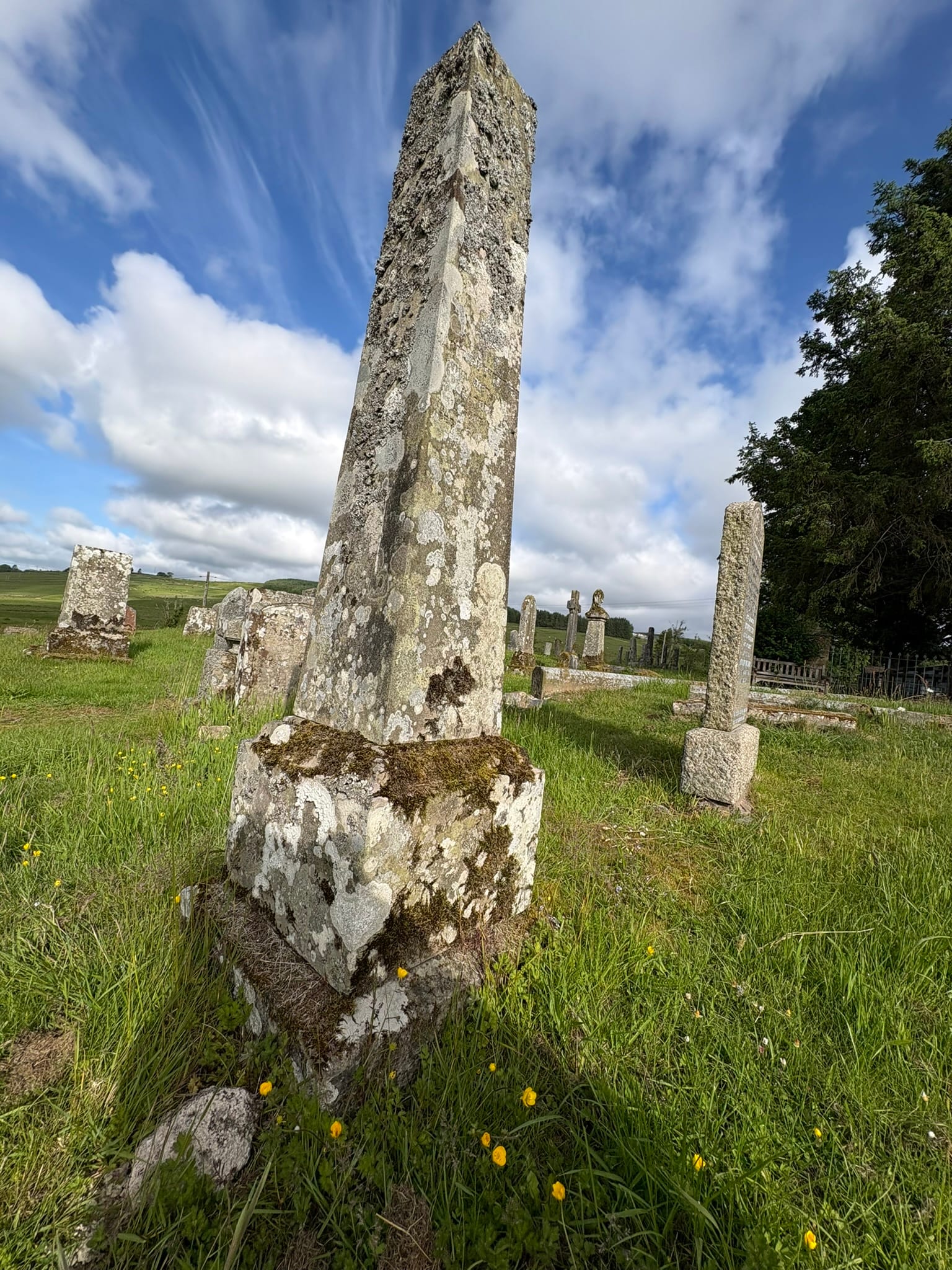
Before moving to later generations, the yard presents another beautiful, silent shape. Standing against the boundary dike is an ancient sandstone marker, carved into a graceful ogee arch—a pointed teardrop apex. Its face has turned a deep, weathered charcoal, entirely blanked out by dark moss and orange lichens. Right near it rises a towering, rough-hewn stone obelisk, its base wrapped in velvet moss and its columns covered in white lichen like a second skin. These faceless monuments represent the foundational generations who worked this ground long before modern granite arrived, standing as symbols of collective endurance.
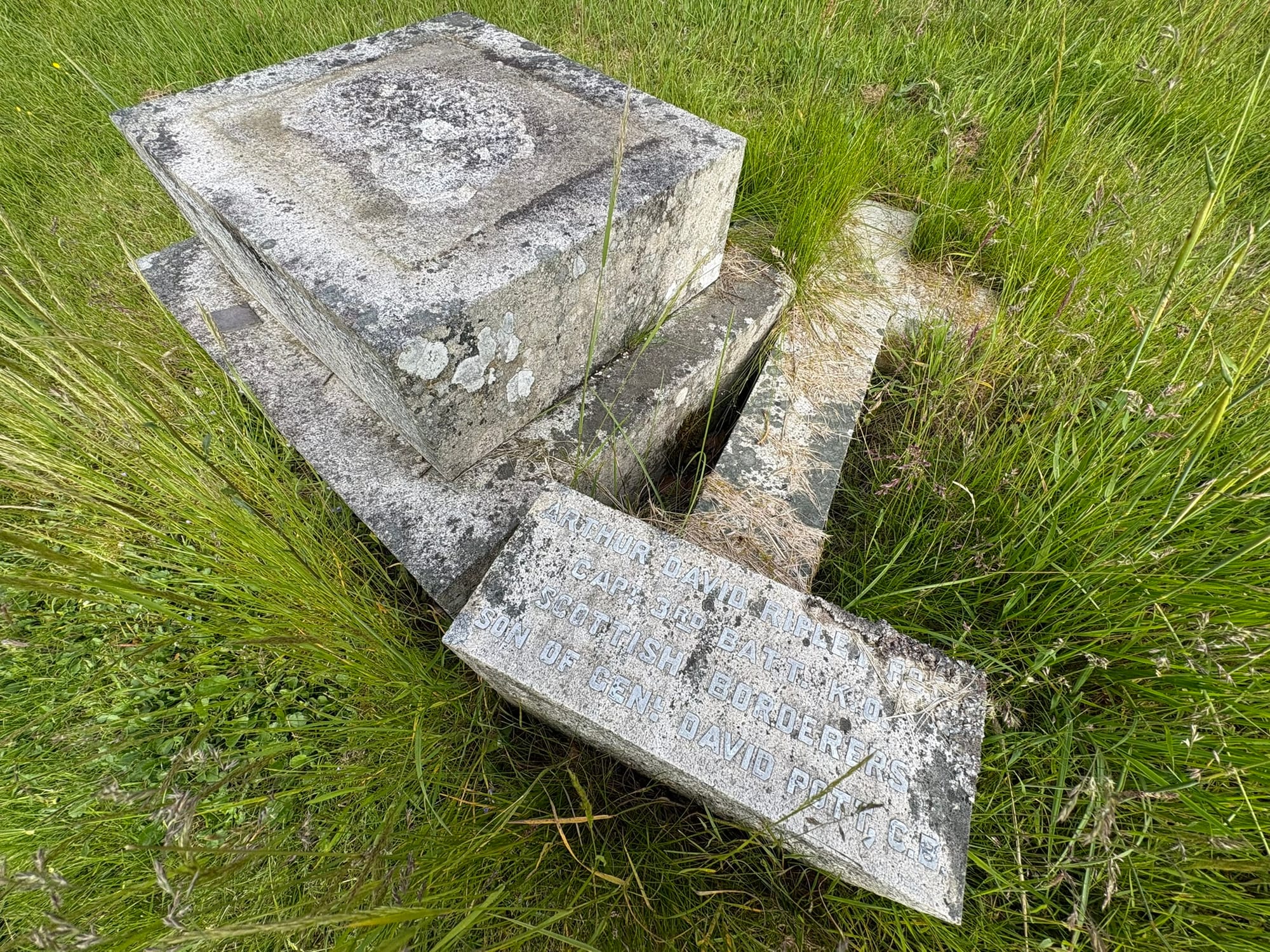
The ultimate meaning of this entire landscape is cast in a shattered stone cross lying in the grass, commemorating Captain Arthur David Ripley Forman of the King's Own Scottish Borderers. When this family faced their devastating wartime heartbreak, they did not build an exclusive, walled-off tomb to hide away. Instead, they turned their private sorrow into a permanent, practical gift for the parish's working families: they funded and built the community hall.
The very roof that now protects the carpet bowls, the yoga, and the seasonal warmth exists because a family in this yard chose to support the living. While their stone cross has fractured in the damp grass, their true monument stands perfectly intact, vibrant, and useful just down the road.
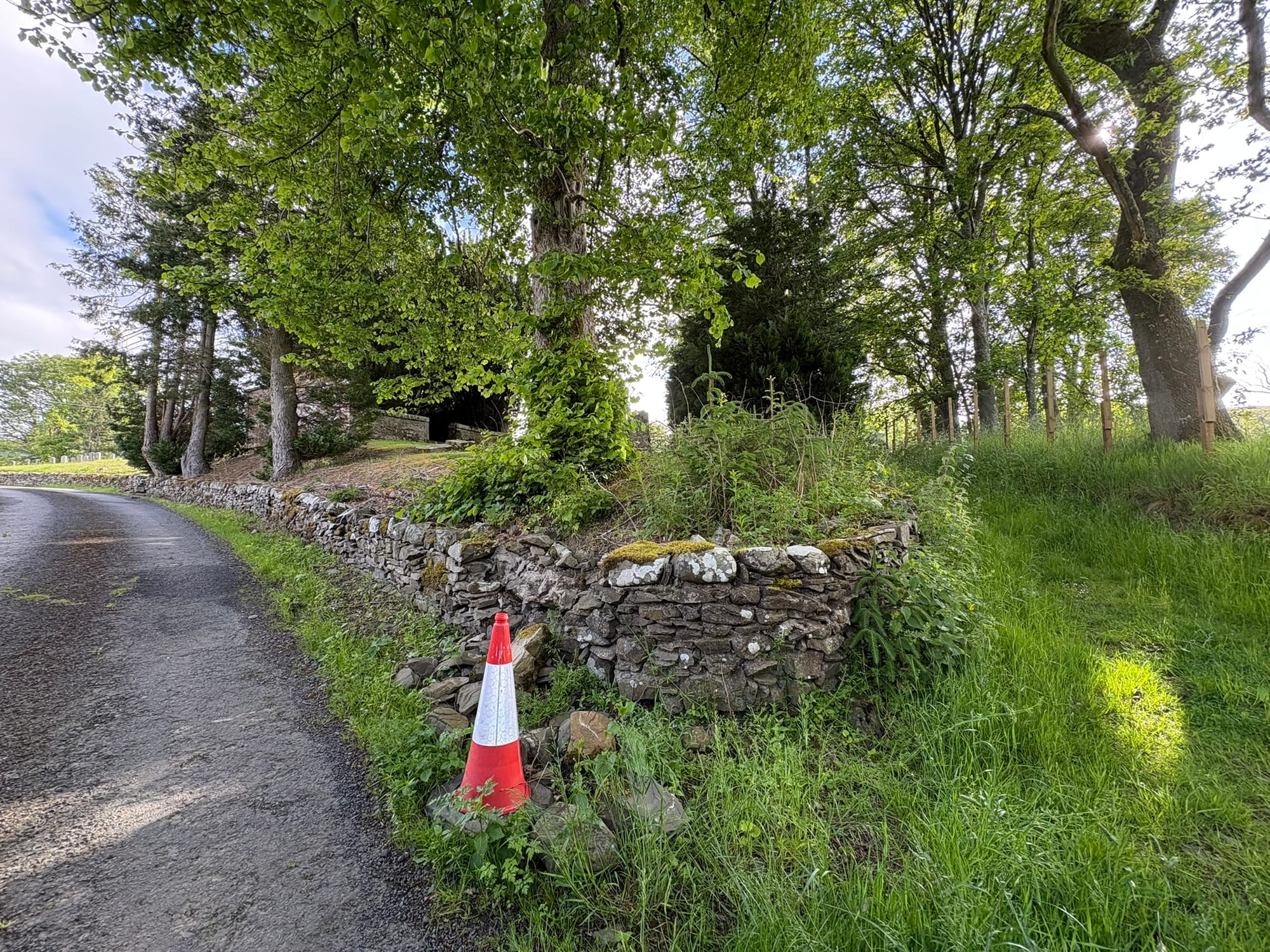
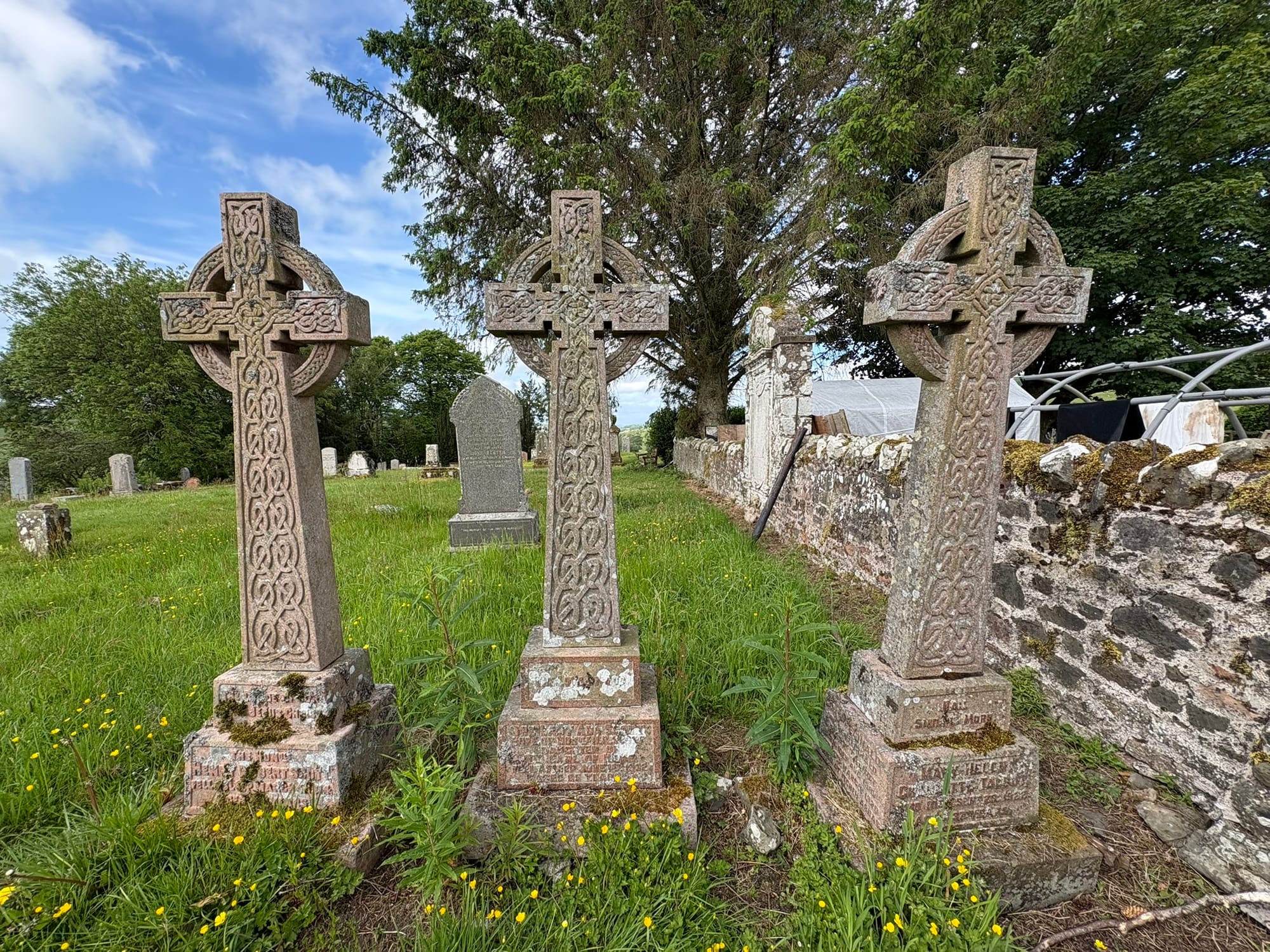
The yard's physical layout forces a final dialogue. On one side, a silent row of diverse headstones stands flat against the old drystone boundary dike, showing a line where wealth and lineage meet the same dirt. Directly opposite them tower three grand, intricately carved Celtic wheel crosses of pink granite, representing an elite attempt to assert permanent belonging through complex stone knotwork.
But the landscape quietly resolves the debate. The ground beneath both rows is an identical explosion of life, thick with summer grass and a bright carpet of yellow wildflowers. The moss is already climbing the bases of those grand Celtic crosses, slowly reclaiming the premium stone. Beyond the dikes, the rolling green pastures stretch into the distance, framing both rows within the same working landscape of the present day. The dead do not look inward; they look across at each other and out at the living valley.
Continuing the Story
Ultimately, the lives and deaths of the valley’s ancestors remain tied to the present generation. If we treat the kirkyard as merely a collection of old stones, the landscape becomes static. The people who came before endured immense physical hardships to establish a community here, and their work brought the peace and comfort enjoyed today.
This legacy is the foundational story that everyone who calls this valley home has inherited. It provides the bedrock for new beginnings, ensuring that newcomers aren't starting from nothing but are joining a proud, resilient lineage. The click of the bowls in the Forman Hall and the daily labour on the hillsides are part of an unbroken human chain. We are the living face of the Borthwick Valley, and the stories written in these peaceful stones depend entirely on the choices of the present to carry their meaning into tomorrow.
A Note on Our Intent: The Sacred Infrastructure of Belonging
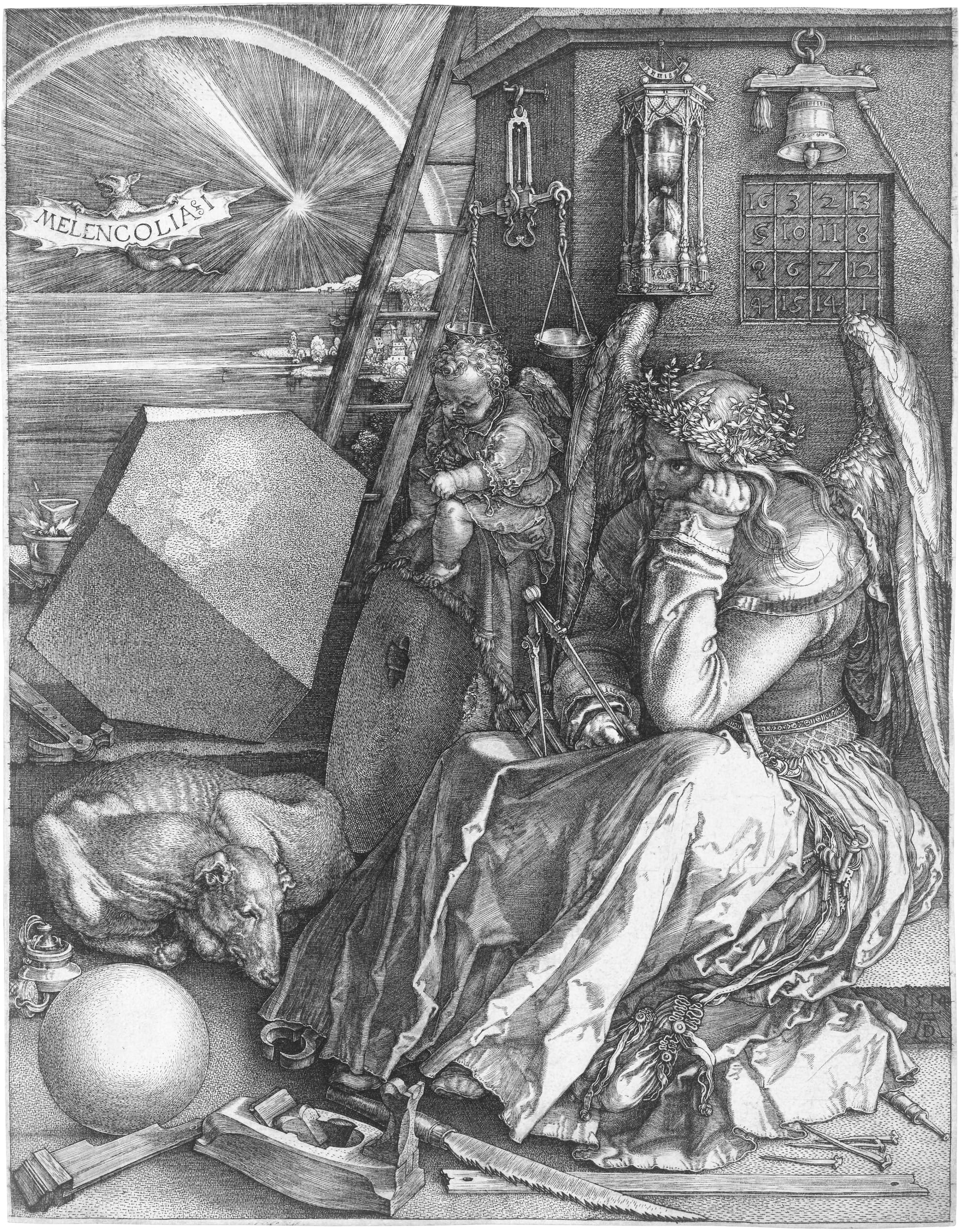
In an increasingly uniform and secularised world, local landscapes are systematically treated like a blank grid of real estate, stripping communities of their unique depth and leaving individuals to navigate the future entirely isolated. Secularism Excel-sheets the world into transactional efficiency, but it leaves our inner lives stranded. We are reminded of Albrecht Dürer’s masterpiece, where the winged figure sits paralysed amongst the cold geometric shapes and calculating tools of pure rationalism. It is a striking portrait of modern melancholy: possessing all the technical instruments to measure the earth, but completely lacking the spiritual infrastructure to belong to it. When we erase the quiet, sacred baseline of our history, we sacrifice our unique identity to that flat, uniform void.
This exploration is a direct counter-narrative to that secular alienation. The drone camera utilised at the head of this piece doesn't act as the elite eye of a corporate developer surveying a map from above; instead, it acts as a telescope from an underclass submarine, breaching the surface to bring the deep, submerged history of the valley into clear view. The stones of Roberton Kirkyard and the vibrant walls of the Forman Memorial Hall are not relics of a closed, dilapidated past, nor are they a ruin to stand upon in despair. They are living anchors. By preserving the memory of the sacrifices, trials, and quiet peace embedded in this soil, we offer a trusted, permanent foundation. It is a shared space where generational families can reconnect with their roots, and where newcomers can drop their guards, open up, and find a profound sense of true belonging. We preserve this story so that we do not stand alone amongst cold, measured ruins, but continue writing a resilient, shared history together.