
Abstract
This essay examines the proliferation of No Cold Calling Zones (NCCZs) across rural settlements in the Scottish Borders—specifically contrasting the signed parishes of Ancrum and Lilliesleaf with the unbranded landscape of Ashkirk. Framed officially as benign consumer protection initiatives administered by Trading Standards and Police Scotland, NCCZs operate sociologically as micro-territorial governance tools. By analysing the paralegal architecture of these zones, the privatisation of state enforcement, the cross-jurisdictional creep of community councils, the historical erasure of itinerant enterprise, and the systemic protection of corporate supply chains, this paper demonstrates how municipal branding engenders a defensive parochialism. This administrative moralism ultimately recodes economic survival strategies and unauthorised human presence as deviant, transforming rural thresholds into instruments of village respectability and spatial cleansing.
Introduction: The Metal Sign on the Lamppost
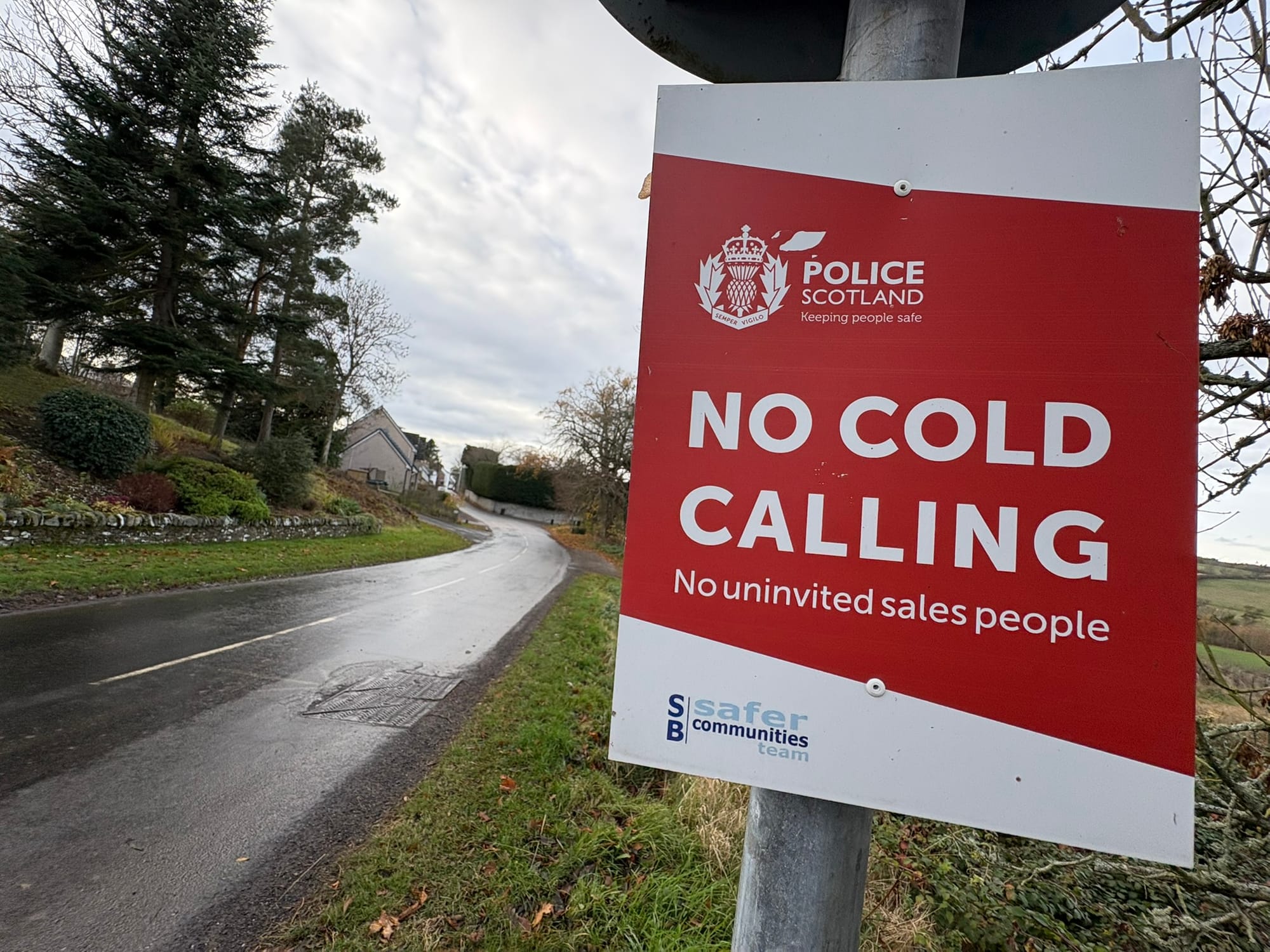
In contemporary rural governance, the apparatus of social control rarely arrives with the dramatic sweep of state decree; more often, it arrives bolted to a lamppost. Across the Scottish Borders, brightly branded metal signage declaring a "No Cold Calling Zone" has become a familiar fixture of village entries. To the casual observer, these markers represent a municipal shield—an administrative embrace protecting elderly and vulnerable residents from rogue tarmac contractors and high-pressure doorstep sales.
However, looking past the humanitarian rhetoric reveals a striking sociological paradox. Doorstep cold calling is not inherently a criminal offence under UK law, and local authorities possess no statutory power to enact an outright ban on commercial visitation. To understand how these zones actually function, we must examine the core mechanics of their deployment.
I. The Legal Paradox, Aesthetic Markers, and the Outsourced State
From a legal standpoint, local authorities cannot easily criminalise the act of knocking on a door. Because formal law lacks the statutory power to enact an outright ban on commercial visits, NCCZs rely entirely on a paralegal architecture backed by Trading Standards:
- Aesthetic Markers: The deployment of bright, standardised council and police-branded signage at the thresholds of housing estates or rural lanes acts as a visual deterrent.
- Manufactured Consensus: A zone requires a localised petition process (often led by a "Zone Champion") to demonstrate that a threshold majority consents to the designation.
This creates a self-policing perimeter. The "police power" is effectively outsourced to the resident via the window sticker and the boundary sign: the physical boundary shifts the burden of enforcement from the state to the occupant, who is scripted to point at the sign and reject the outsider.
II. Spatial Cleansing and the Redefinition of "Legitimate" Presence
In rural and dispersed geographies like the Scottish Borders, where informal surveillance and community familiarity are already high, NCCZs codify a strict socio-spatial hierarchy regarding who belongs in public-private transitional spaces:
- The "Legitimate" Commercial Actor: Delivery drivers, utility workers, and approved members of schemes like the Scottish Borders Trusted Trader network are pre-sanctioned by municipal frameworks. They move through these zones unhindered.
- The "Suspicious" Outsider: Independent traders, itinerant workers, hawkers, and unannounced solicitors are instantly recoded as deviant or pre-criminal. Their bodily movement across the threshold is rendered "out of place."
By spatialising suspicion, the zone pre-emptively criminalises economic survival strategies that operate outside corporate or municipal registers.
III. Mutual Surveillance and Community Panopticism
NCCZs rely heavily on what Michel Foucault or Zygmunt Bauman might recognise as dispersed, lateral surveillance. Once a zone is established, the neighbours become the primary apparatus of enforcement.
- A stranger walking up a path isn't just an uninvited visitor; they are a breach of the collective agreement.
- Residents are enrolled as active monitors of their own micro-territory, reporting "suspicious" vehicles or unverified callers to Trading Standards or Police Scotland via dedicated channels (such as local reporting lines or regional initiatives like the Scottish Borders Council's "Scam Van" outreach).
This fosters a defensive parochialism—a mechanism where community cohesion is paradoxically built upon the exclusion and suspicion of the mobile outsider.
IV. Patchwork Geography: Ancrum, Lilliesleaf, and the Silence of Ashkirk
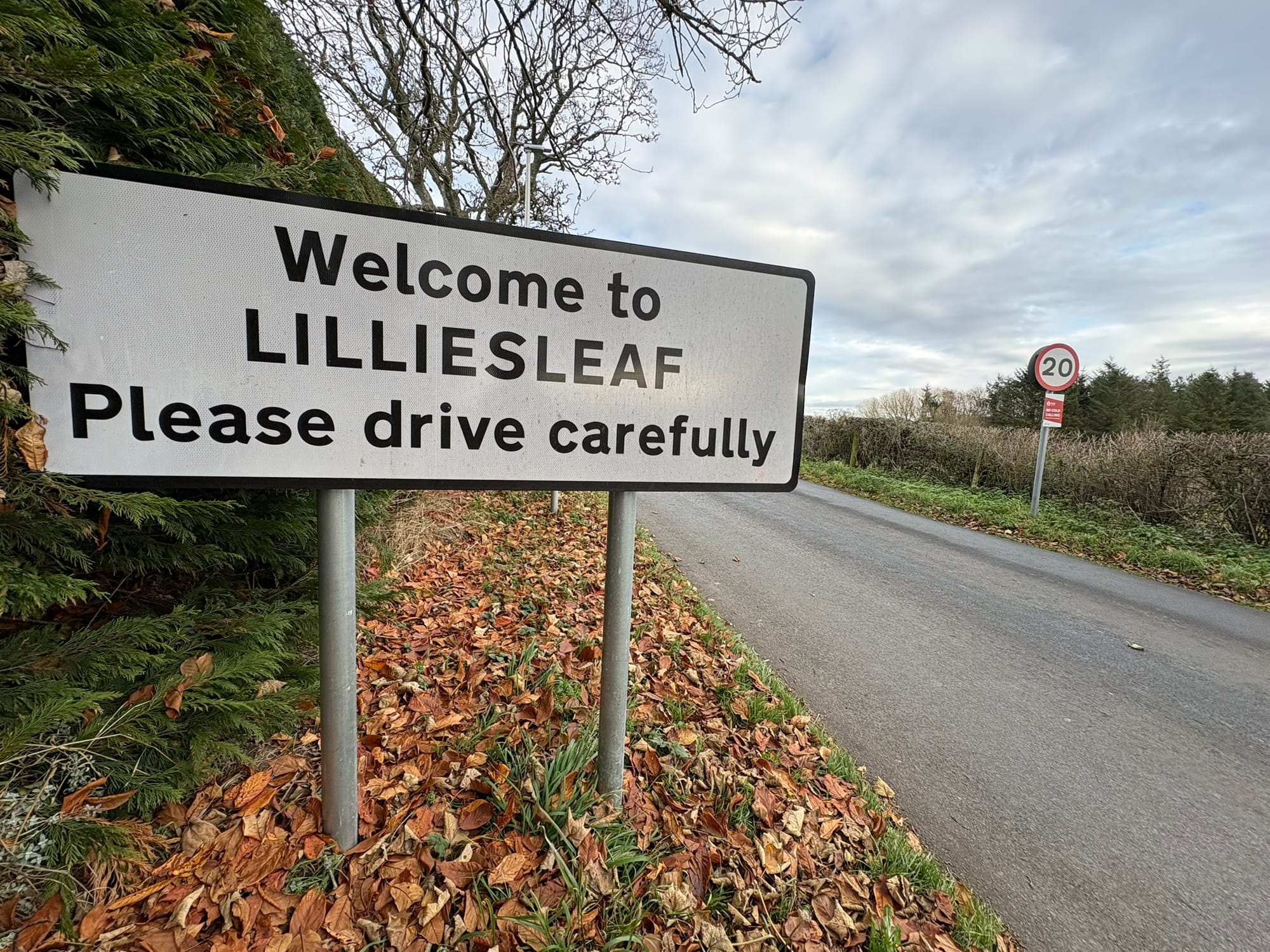
The uneven distribution of these zones across the Borders underscores their grassroots, ad-hoc nature. While Ancrum and Lilliesleaf display proud regulatory perimeters, Ashkirk sits entirely unbranded—possessing no signs, no formal zone designation, and no municipal warning perimeter.
This patchwork geography exposes the myth of regional protection. A commercial traveller can drive through Ashkirk completely unhindered, cross a parish boundary into Lilliesleaf, and suddenly find their bodily movement treated as a municipal infraction. This disparity reveals that spatial policing in the Borders is fundamentally tethered to local social capital and administrative mobilisation.
NCCZs are not deployed systematically by regional planners; they require an active domestic lobby. A village acquires a zone only when galvanised by a vocal local catalyst—a "Zone Champion" or an anxious cohort within the local community council willing to petition authorities, host meetings, and manufacture a threshold majority of resident consent. Ashkirk’s lack of signage does not signify a legal vacuum; rather, it reflects a community that has bypassed—or simply lacked the local administrative anxiety required to activate—this specific apparatus of micro-territorial branding.
V. The Administrative Creep of Community Councils
As these zones multiply, the institutional bodies driving them—the community councils—frequently exceed their statutory remits. Defined under Scottish local government frameworks as hyper-local consultative bodies meant to reflect the immediate sentiment of a single village, community councils are increasingly behaving as regional interest groups.
When neighbouring parishes begin coordinating, pooling lobbying efforts, and coordinating with regional police command to secure uniform enforcement standards, a clear democratic deficit emerges. A small, un-elected coterie of civic volunteers begins driving regional spatial policies that impact unincorporated thoroughfares, rural lanes, and adjacent settlements (such as Ashkirk) that never opted into the framework.
This administrative networking generates a distinct "Border Guard" mentality. The spatial anxiety of one village bleeds into the next: as Lilliesleaf secures its perimeter, residents grow anxious that displaced itinerant traders will migrate down connecting routes into unprotected areas. To close these perceived gaps, active councils lobby for sweeping, area-wide normalisation, overstepping their consultative mandate to sanitise entire rural transit corridors.
VI. The Exception of Ideological Transgression: Jehovah’s Witnesses and the Micro-Physics of the Doorstep
The limits of this municipal policing framework become starkly apparent when confronting non-commercial visitors. Legally and administratively, NCCZs do not apply to Jehovah’s Witnesses, political canvassers, or charitable proselytisers. Protected by Articles 9 and 10 of the European Convention on Human Rights (ECHR) regarding freedom of expression and religious practice, ideological callers remain entirely exempt from Trading Standards restrictions.
Yet, at the micro-physical level of the domestic doorstep, this legal distinction collapses. To a resident inside an NCCZ, an uninvited religious caller breaching the path represents the exact same disruption of domestic sanctity as a rogue tarmac contractor.
Because the state cannot legally banish religious proselytising via council signage, the encounter shifts entirely from municipal enforcement to interpersonal micro-politics:
- The Weaponization of Signs: Residents frequently weaponise NCCZ warnings against religious callers, relying on the outsider's potential intimidation or ignorance of employment law to enforce a broader cultural sanitisation of the street.
- The Counter-Bureaucracy: Paradoxically, secular residents seeking absolute spatial privacy often have to appeal to a religious bureaucracy—requesting placement on the local Kingdom Hall’s private "Do Not Call" list—because the secular municipal state cannot legally guarantee their insularity.
When persistent callers ignore these informal, community-enforced boundaries, interactions rapidly transition into deviance labelling. In close-knit rural parishes, neighbours monitor how doors are answered, evaluating the stranger’s presence through a lens of defensive parochialism where community cohesion is forged through the exclusion of the uninitiated.
VII. The Historical Extinction of the Itinerant Pioneer
The full ideological closure effected by these zones becomes clear when we look at the historical genealogy of modern commerce itself. Figures like Aaron Montgomery Ward or Alfred Fuller—peddlers and travelling salesmen whose early door-to-door hustling directly birthed global retail empires—depended entirely on the absolute openness of the unmonitored threshold.
Had the paralegal perimeters of Ancrum or Lilliesleaf been active two centuries ago, these foundational entrepreneurs would have been choked out at the garden gate. An unannounced traveller marching up a path with a suitcase of goods would not be viewed as an economic pioneer; they would trigger an immediate sequence of rural spatial policing:
- A neighbour peering through lace curtains would log the anomaly via community networks.
- The homeowner, primed by council signage, would point upward at the lamppost and order them off the property under implied threat of police or Trading Standards intervention.
By locking down the village threshold, modern NCCZs do not eliminate door-to-door enterprise—they corporate-capture it. Consider the traditional milkman: once an accepted, foundational fixture of rural and urban morning life, walking up paths to offer uninvited trade and subscription services. Today, an independent local dairy trying to start up that exact same doorstep model is flagged by the zone's panoptic mechanics as an unvetted intruder. Conversely, massive corporate delivery fleets and consolidated supermarket grocery apps navigate these zones unhindered because they operate under registered corporate brands, digital interfaces, and state-vetted VAT numbers.
The metal sign on the lamppost protects corporate distribution models while pulling up the ladder on grassroots, independent economic mobility.
Conclusion: The Cult of Respectability on the Rural Threshold
The No Cold Calling Zones of the Scottish Borders are emblematic of a broader sociological shift: the rise of administrative moralism and defensive village respectability in rural spaces. Far more than simple consumer protection tools, these zones represent an attempt to sanitise the Borders landscape—replacing organic, unpredictable human encounters with pre-sanctioned corporate mobility and state-vetted commercial channels.
By outsourcing surveillance to the homeowner, fracturing regional geography through ad-hoc petitioning, and empowering overzealous community councils to police parish boundaries, NCCZs institutionalise a culture of suspicion. In villages like Ancrum and Lilliesleaf, the metal sign on the lamppost does not merely keep out the rogue trader; it marks the triumph of a defensive, micro-panoptic order that treats every unannounced human step as a transgression against the fragile peace of the landed domestic sphere, effectively locking out the very history of independent enterprise that came before it.