Grand political blueprints—whether utopian socialism or the creeping administrative nanny state—always rot from the same root: someone decides they know how everyone else ought to live, and builds an apparatus to keep people in their place. C.S. Lewis captured that exact danger when he warned against "omnipotent moral busybodies"—observing that those who torment us for our own good will torment us without end, because they do so with the approval of their own conscience. Against that machinery of self-righteous control, real communities have only ever survived on one unpretentious rule: those that can, do a little more for those that can't. No committee required. No moral fanfare. Just practical decency between equals.
In the modern rural parish, however, that unscripted reciprocity is hollowed out by an older, harder obsession: status. On a frontier, status has always been the problem. Centuries of border suspicion taught small valleys to treat every stranger as a threat and every square yard of ground as contested turf. The peel towers may be ruins now, yet an entrenched clique of sociolords still runs the exact same frontier software—projecting an unspoken feudal mindset onto a modern street. Here, anyone who names the game gets shut up fast, while real power stays locked inside a closed loop of hereditary social privilege, insular gatekeeping, and weaponised heritage—reducing outsiders to a quiet state of micro-serfdom, tolerated only so long as they remember whose turf they are standing on.
Subjected to the Gaze
Outside the parish boundary, the wider culture talks endlessly about inclusion, universal standards, and civic duty. Inside the village, those abstractions hit a wall and die—not because newcomers arrive preaching textbooks, but because anyone entering the street is immediately subjected to the gaze, lensed by the oppression itself.
You do not need to challenge a single rule to be marked; the feudal optics of the parish decide what you are before you ever speak. In an insular village, any outward expression is automatically read as a dominant statement. Speak plainly, carry yourself with confidence, pursue your own craft, or simply refuse to shrink, and the gaze translates ordinary human aliveness into an assertion of dominance over the street. Keep to yourself and you are aloof; step forward to help and you are trying to take over; express yourself openly and you are staking a claim on someone else's turf.
Localism here isn't broad or universal; its horizon ends at the edge of the parish, turning insular, conservative, and fiercely arrogant. The village raises its informal standards for exclusion specifically to keep the lens firmly in the hands of the insiders. If you try to name the gaze or challenge how you are being framed, you get shut up fast—leaving you with two choices: dim yourself down to nothing and keep quiet, or find yourself frozen out of the room entirely.
Birthright, the Keys, and Micro-Serfdom
That gaze holds power because authority on an old frontier rarely sits in a public constitution; it sits in birthright, property leverage, and the hereditary grip of the sociolords.
Even where the old estates have vanished, a handful of entrenched families and self-appointed barons still treat the parish not as a shared civic commons, but as their private social fiefdom. They carry an ingrained feudal mindset: the keys to the kingdom are inherited through name, tenure, and local lineage, never earned through hard work, quiet decency, or decades of living there.
Everyone else is placed in a state of micro-serfdom, trapped in a narrow double bind: to fit in at all, the outsider must be simultaneously remarkable and unthreatening. Ordinary human equality is never on offer. You have to bring something the sociolords can harvest—skills, free labour, money, or decorative prestige—yet remain utterly domesticated, never exercising independent judgment or questioning how things are run. Like tenants on a shadow estate, your usefulness maintains the village, while authority stays locked inside the house. Control over halls, tracks, committees, and local reputation provides all the silent leverage needed to keep heads down. The moment an outsider stops being convenient and forgets their station, the trapdoor opens.
Horizontal and Vertical: The Spatial Geometry of the Kirkyard
This sorting of birthright insiders and conditional outsiders is not a modern quirk of rural life, nor a byproduct of recent demographic shifts. It has been etched into the physical geometry of the parish for centuries.
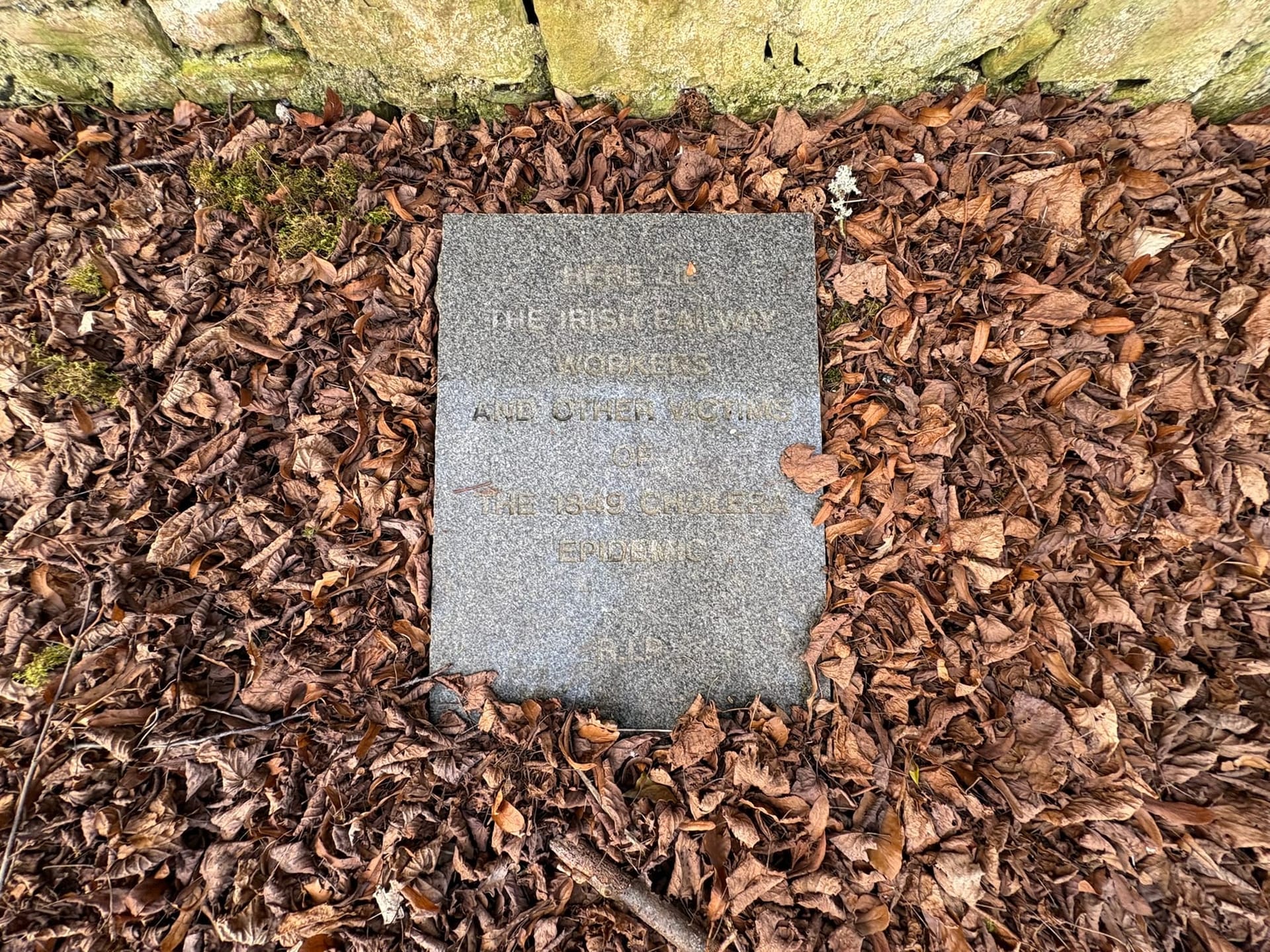
Walk into Ancrum kirkyard and the hierarchy of belonging is mapped directly into the turf. Established parish families occupy the open ground in vertical order—upright, carved, named headstones asserting permanent lineage, land, and standing. Tucked right against the base of the kirk wall, half-swallowed by dead leaves, lies a single flat granite slab. It marks the mass grave of the Irish railway workers and local victims of the 1849 cholera epidemic.
The navvies were brought in to cut the rail infrastructure that connected the Borders to the wider industrial world, their labour essential to modernising the region. Yet even in death, the birthright boundary held absolute: insiders received individual, vertical monuments; the transient outsiders whose labour built the line were laid horizontal and nameless against the stone wall of the church. Apologists might blame the lack of individual names on the cost of masonry, yet orientation is not a matter of budget. Setting the slab flat in the earth rather than upright in the visual horizon of the yard was an explicit spatial decision—ensuring that even in stone, transient outsiders remained below the sightline of established parish lineage.
That distinction between the vertical insider and the horizontal outsider never disappeared—it simply updated its hardware. Where nineteenth-century parish authority used granite, turf, and the kirk wall to mark who held the keys, the modern frontier machine uses 20 mph reset switches, laminated civic warnings, and the airbrushed ledger of collective village awards. The tools have moved from ecclesiastical stone to municipal steel, but the underlying rule remains unchanged: outsiders are permitted only on the parish's terms, and the landscape itself is arranged to remind everyone where the line is drawn.
Curated Heritage, Village Awards, and the Renegade Penalty
To keep the lock turning smoothly, every closed shop needs a public mythology that makes exclusion look noble. As philosophers Justin Tosi and Brandon Warmke argue in their work on moral grandstanding, public displays of civic virtue are rarely about helping others; they are used to claim status, dominate social space, and police group boundaries. In the parish, that status-policing runs through three interlocking rituals: the heritage society, the collective village awards, and the individual containment trophy.
Instead of looking honestly at how frontier places were actually built—by transients, drovers, labourers, incomers, friction, and survival—captured heritage groups act as legitimacy factories for the sociolords. They scrub out the messy human truth and replace it with a curated pedigree belonging strictly to the "old families." Belonging is cemented into stone and deed, enforced not with loud hostility, but with cold unreaction—a polite, impenetrable blankness toward anyone who isn't stitched into the approved lineage. In a street like that, the houses belong to the village, while the people living in them merely belong to the houses—temporary occupants measured against the names on the title deeds. Once history is turned into private property, xenophobia and petty parochialism get handed back to the village disguised as history lessons.
Alongside that sanitised past sits the annual pageant of collective village awards—the Village of the Year competitions and civic rosettes that paint an impossible, airbrushed backdrop of rural harmony. These awards erect an idealised stage set upon which everyone on the street is expected to sacrifice themselves—and each other—to keep up appearances. To protect the shiny official narrative, grievances must be swallowed, friction hidden, and neighbours quietly policed so nothing messy spoils the postcard. Anyone who refuses to perform, or who points out the cold exclusion behind the brochure, isn't just ignored; they are framed as sabotaging the parish's collective standing.
And when an individual award is handed out, it rarely signals genuine power-sharing; more often, it illuminates a perceived threat—marking out the elephant in the room who is beginning to overgrow their patch. When an outsider or restless resident develops too much independent momentum outside the clique's control, pinning a trophy on them is a classic move of feudal containment. It drags their autonomy back under parish jurisdiction, signalling that their patch has been noticed while trying to domesticate them back into the remarkable and unthreatening role—acknowledging their presence without ever handing over a key.
Yet the sharpest irony of this feudal machine is who suffers its harshest cruelty. Outsiders are expected anomalies; they are merely contained behind the velvet rope. The fiercest persecution is reserved for those the sociolords consider their own—the non-conforming insider who falls out with the clique, refuses to police the line, or commits the cardinal sin of associating freely with outsiders. On a frontier, breaking ranks with your own kin-group was always treated as treason. An outsider gets cold unreaction; a rebellious insider is treated as a traitor to the house, stripped of inherited immunity and subjected to a far heavier penalty to ensure nobody else inside the fence dares step off the script.
The Real Pushback
Genuine localism isn't built by heritage committees, Village of the Year pageantry, or sociolords hoarding status like fortified stone. On a frontier, status has always been the poison—the excuse for turning neighbours into rivals, insiders into wardens, and newcomers into serfs. Real localism is an unspoken boundary forged by people who meet on level ground without keeping score—where people come before property, parity replaces pedigree, and help is given without demanding deference in return.
When a village trades that quiet decency for hereditary keys, cold unreaction, and airbrushed civic awards, it hasn't protected its heritage. It has just turned itself into a feudal closed shop where the stone and the plaque matter more than the living.
Notes & References
- Foucault, Michel. Discipline and Punish: The Birth of the Prison. Translated by Alan Sheridan. New York: Vintage Books, 1977 (see "Panopticism," pp. 195–228, on how asymmetric visibility internalises compliance without continuous formal enforcement).
- Bourdieu, Pierre. "The Forms of Capital." In Handbook of Theory and Research for the Sociology of Education, edited by John G. Richardson, 241–258. New York: Greenwood, 1986; see also Newby, Howard. The Deferential Worker: A Study of Farm Workers in East Anglia. London: Allen Lane, 1977, on traditional paternalism and landed social hierarchy in rural Britain.
- Scott, James C. Domination and the Arts of Resistance: Hidden Transcripts. New Haven: Yale University Press, 1990 (on public transcripts of deference required from subordinate or conditional entrants within closed social orders).
- Memorial inscription, Ancrum Parish Kirkyard, Scottish Borders: "HERE LIE THE IRISH RAILWAY WORKERS AND OTHER VICTIMS OF THE 1849 CHOLERA EPIDEMIC. R.I.P." Laid horizontal against the exterior stone wall of the kirk during the construction of the Hawick branch of the North British Railway (opened 1849). While parish apologists might attribute the absence of individual names to the cost of masonry, orientation is not a function of budget: setting the slab flat in the turf rather than upright in the visual field of the yard was a deliberate spatial choice that kept transient outsiders below the sightline of established parish lineage.
- Goffman, Erving. The Presentation of Self in Everyday Life. Edinburgh: University of Edinburgh Social Sciences Research Centre, 1956 (on "frontstage" impression management and collective team performance).
- Elias, Norbert, and John L. Scotson. The Established and the Outsiders: A Sociological Enquiry into Community Problems. London: Frank Cass, 1965 (the foundational study of how long-established residential cliques monopolise local governance, enforce reputational penalties, and stigmatise newcomers).
- Lipsky, Michael. Street-Level Bureaucracy: Dilemmas of the Individual in Public Services. New York: Russell Sage Foundation, 1980 (on how administrative discretion and civic moralism recode non-conforming presence as deviant).