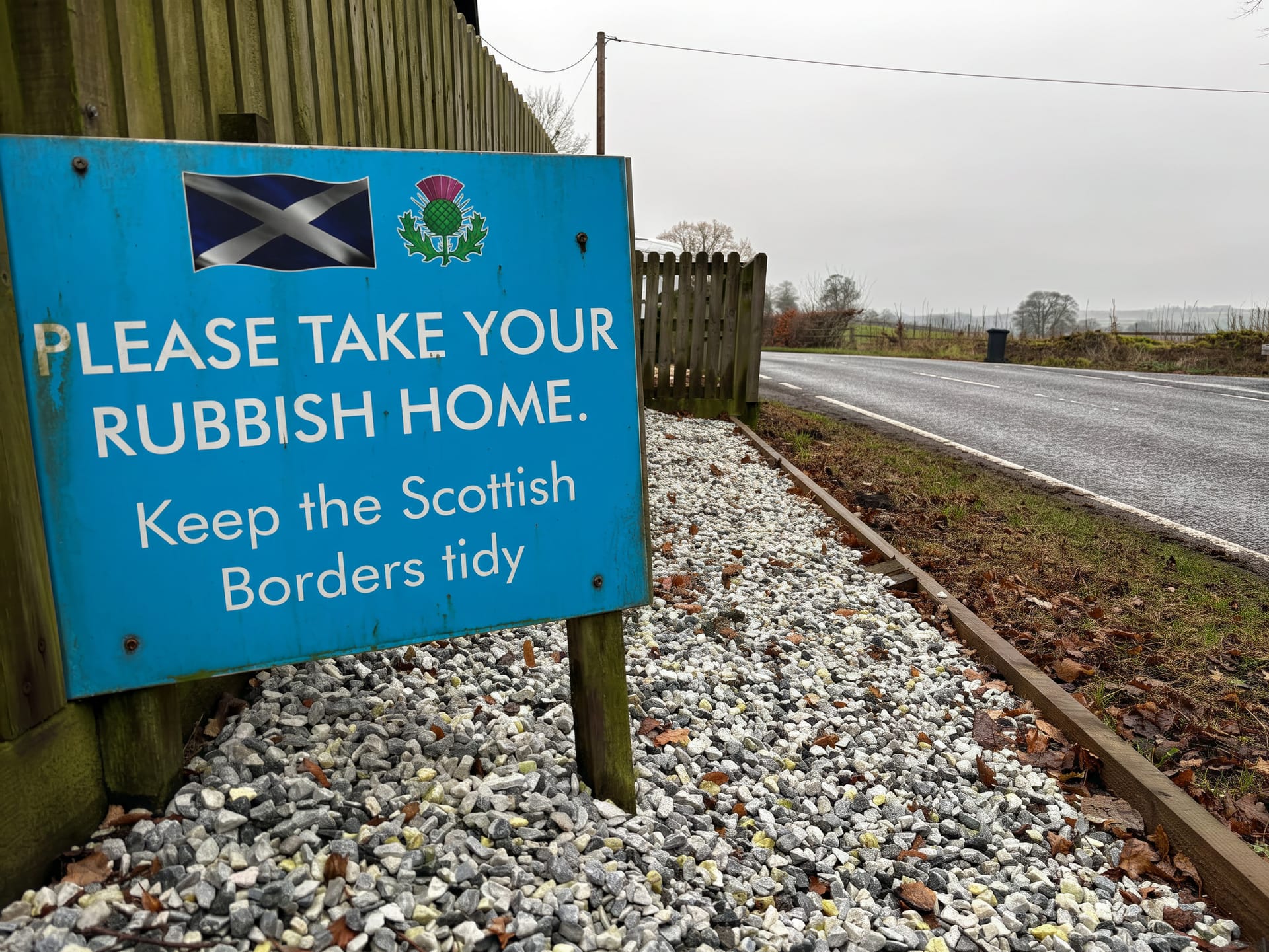
Drive west out of the valley along the Borthwick Water, past the sheep fields and dry-stone dykes, and you scarcely need a map or a wooden signpost to tell you when you are approaching the trees. The verges do the navigating for you. Every few hundred yards, a crumpled takeaway wrapper, a crushed energy drink can, or a discarded plastic bottle sits wedged into the grass—an unbroken breadcrumb trail leading from the main road straight into the forestry car park.
That trail of rubbish captures a deeper failure in how modern tourism interacts with rural land.
The issue is never about restricting who comes here. Open countryside—like genuine belonging—should never be a private club policed by birthright, accent, or postcode. Left to itself, an unvarnished landscape already has its own honest, democratic way of protecting itself: it demands respect through friction. Steep hills, boggy ground, sudden Borders weather, narrow single-track lanes, and basic stone shelters do not ask where you are from or what you earn, but they do require humility. To move through them well, you have to slow down, read the ground, carry what you need, and leave the place cleaner than you found it. That quiet negotiation between person and place is what breeds care.
Modern commercial tourism is engineered to circumnavigate that negotiation altogether.
Amusement Over Enjoyment
At the heart of this shift is a quiet sleight of hand between enjoyment and amusement. Enjoyment is active, relational, and demands your presence; it comes from meeting a landscape on its own terms—feeling the bite of the wind on a ridge, lighting a fire in a damp stone hearth, or noticing how dry-stone dykes follow the contour of a working valley. Amusement is passive, external, and designed to distract you from where you are.
As the Frankfurt School critics Theodor Adorno and Max Horkheimer observed of the modern culture industry, packaged amusement relies on standardisation and frictionless distraction—offering novelty without effort so the consumer never has to confront reality directly.[1] You cannot put a turnstile on stillness, weather, or genuine curiosity. To turn rural land into a predictable revenue stream, the tourism industry replaces slow, self-directed enjoyment with curated amusement—heated pools, timed activity slots, and manicured trails—that can be priced, scheduled, and repeated identically anywhere in Britain. When an experience asks nothing of you except a booking fee, it leaves you detached from the ground beneath your feet.
Two Models of Shelter: The Bothy and the Dome
Compare the experience of walking into a remote mountain bothy—places like Roughside on the edge of Kielder Forest or Haughton Green along the Pennine Way—with checking into a commercial holiday village like the proposed Center Parcs north of Hawick.
Both sit within rural woodland and hill country, yet they operate on opposite moral economies.
A bothy offers no reception desk, no booking system, no running water, and no guarantee of comfort. You reach it on foot, carrying your own fuel, food, and dry layers across ground that makes no concessions to your timetable. Inside, the shelter is sparse: stone walls, a wooden sleeping platform, a hearth, and a shovel. Precisely because there is no paid staff waiting behind you to sweep the floor or haul away your rubbish, the space survives entirely on reciprocal trust. You chop kindling for the next walker, pack out every scrap you carried in, and fasten the latch against the wind. The environment enforces its own quiet discipline: take without giving back, and the shelter degrades for everyone.
A corporate resort like Center Parcs inverts every one of those terms.
Here, access is gated behind a booking fee, perimeter security, and an internal road network built to keep paying guests sealed inside a self-contained commercial bubble. Instead of adapting to the Scottish Borders climate, visitors step into a heated subtropical dome, walk along paved paths, and buy groceries and meals from on-site chains designed to capture every pound spent between Friday and Monday. The company’s environmental messaging leans heavily on "car-free villages" and planted woodland plots, yet the structural reality is an enclosed revenue machine: hundreds of concrete-pad lodges replacing open rural land, while thousands of weekly changeover cars funnel up the A7 and local lanes.
In Henri Lefebvre’s terms, living rural space is flattened into an abstract, commodified product—fenced off, stripped of every demand the environment might make on the visitor, and sold back as a sanitised simulation of nature. [2]
The Myth of the Local Spend
Defenders of rural tourism always fall back on the same promise: that visitors bring vital income into fragile local economies. Yet anyone who lives along a rural route knows how little of that promise survives contact with reality.
Modern self-contained tourism rarely shops locally. Campervans roll into the Borders with their cupboards and fridges already packed to the roof at a suburban Tesco, just as holiday-village guests pre-order supermarket deliveries straight to their lodge door or eat exclusively inside corporate restaurants behind the resort perimeter. The money never touches the village shop, the local butcher, or the independent café down the lane; it stays circulating between national retail giants and corporate shareholders.
What is left behind in the Borders is the physical residue: single-track roads worn down at the edges, passing places blocked, forestry car parks treated as overnight pitches, and the steady trail of supermarket packaging discarded along the verges on the drive up to Craik. Worse still, when state forestry lets genuine public paths like Wolfcleugh collapse behind dense walls of commercial sitka spruce while private developers enclose hundreds of acres behind resort barriers, the countryside is squeezed from both sides—less open access for those willing to walk with humility, and more commercial extraction for those paying to be insulated from the elements.
Why Friction Matters
The Scottish Borders does not need walls to protect it, nor does it need velvet ropes deciding who belongs. Left intact, the land already knows how to ask for respect—through steep ground, cold wind, stone shelters, and open paths that reward patience over entitlement.
When we engineer away that friction in the name of convenience and corporate profit, we sever presence from responsibility. People pass through a working valley as detached consumers rather than guests—and the verges along the road to Craik carry the proof.
Notes & References
- Theodor W. Adorno and Max Horkheimer, Dialectic of Enlightenment (1944; trans. Edmund Jephcott, Stanford University Press, 2002), pp. 94–136. Their analysis of the "culture industry" traces how leisure is standardised into passive amusement that relieves consumers of effort while binding them to commercial consumption.
- Henri Lefebvre, The Production of Space (1974; trans. Donald Nicholson-Smith, Blackwell, 1991), pp. 49–53, 352–356. Lefebvre examines how capitalist development converts lived, social landscapes into "abstract space"—homogenised, enclosed, and organised around extraction rather than everyday stewardship.